Home
Class 12
PHYSICS
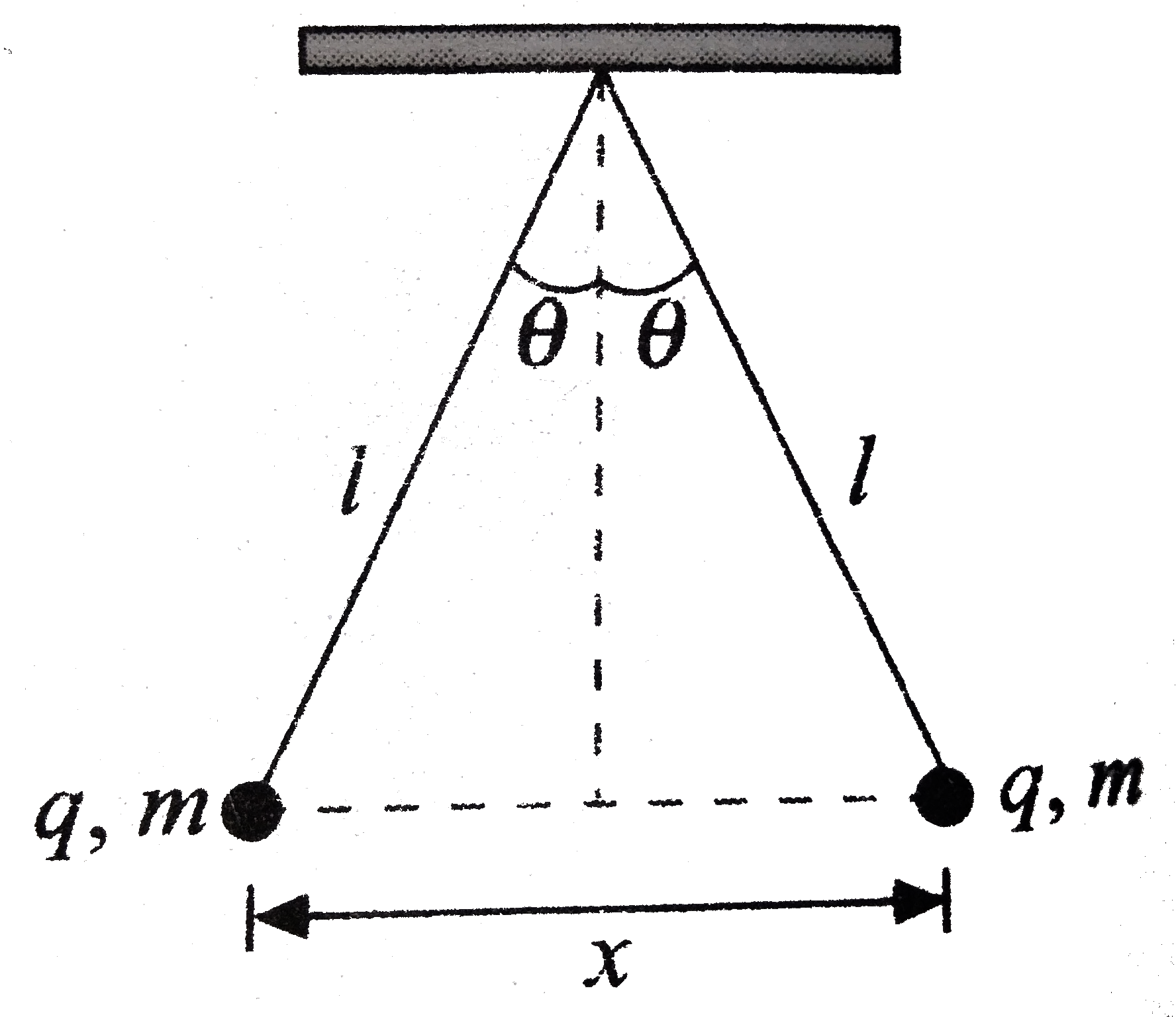
Two similar balls, each of mass m and ch...

Two similar balls, each of mass m and charge q, are hung from a common point by two silk threads, each of length l. Prove that separation between the ball is `x=[(q^(2)l)/(2 pi epsilon_(0)mg)]^(1//3)`, if `theta` is small
Find the rate `(dq)/(dt)` with which the charge should leak off each sphere if the velocity of approach varies as `v=a//sqrt(x)`, where a is a constant.

Text Solution

Verified by Experts

Force of electrostatic repulsion :
`F=(q^(2))/(4piepsilon_(0)x^(2))`
For equilibrium of each sphere :
`T cos theta=mg`

`Tsintheta=F=(q^(2))/(4piepsilon_(0)x^(2))`
`implies (F)/(mg)=tantheta`
`implies (q^(2))/(4piepsilon_(0)x^(2)(mg))=tantheta~~sintheta=(x)/(2l)" "[because thetararr0]`
`implies x=((q^(2)l)/(2piepsilon_(0)mg))^(1//3)" "...(i)`
From equation (i)
`q^(2)=(2piepsilon_(0)mgx^(3))/(l)`
Differentiating both sides with respect to time :
(ii) `2q(dq)/(dt)=(2piepsilon_(0)mg)/(l)3x^(2)(dx)/(dt)`
Now, `(dx)/(dt)` = velocity of approach = v = `(a)/(sqrt(x))`
`((2piepsilon_(0)mg)/(l))^(1//2).x^(3//2)(dq)/(dt)=(3piepsilon_(0)mg)/(l)x^(2)((a)/(sqrt(x)))` using equation (i)
`implies (dq)/(dt)=(3)/(2)asqrt((2piepsilon_(0)mg)/(l))`
Promotional Banner

Similar Questions

Explore conceptually related problems

Two identical pith balls, each carrying charge q, are suspended from a common point by two strings of equal length l. Find the mass of each ball if the angle between the strings is 2theta in equilibrium.

Two indentical pith balls, each carrying charge q, are suspended from a common point by two strings of equal length l. Find the mass of each ball if the angle between the strings is 2theta in equilibrium.

Two small spheres, each having a mass of 20 g, are suspended form a common point by two insulating strings of length 40 cm each. The spheres are identically charged and the speration between the balls at equilibrium is found to be 4 cm . Find the charge on each sphere.

Two similar balls of mass .m. are hung by a silk thread of length L and carry similar charges Q as in Asssuming the separation to be small. The separation between the halls (denoted by x) is equal to

Two identical small bodies each of mass m and charge q are suspended from two strings each of length l from a fixed point. This whole system is taken into an orbiting artificial satellite, then find the tensio in strings

Two small spheres each of mass m and charge q are tied from the same rigid support with the help of silk threads of length L . They make angle theta with the vertical as shown in the fig. If length L is decreased, then angle theta with the vertical.

Three identical small balls, each of mass 0.1 g, are suspended at one point on silk thread having a length of l = 20cm . What charges should be imparted to the balls for each thread to form an angle of alpha = 30^@ with the vertical?

Two identical balls , each having a charge q and mass m , are suspended from a common point by two insultating strings each of length L . The balls are held at a separation x and then released. Find (a) the electric force on each ball (b) the component of the resultant force on a ball along and perpendicular to string (c ) the tension in the string (d) the acceleration of one of the balls. Consider the situation only for the instant just after the release.

Two small balls, each having charge q, are suspended by two insulating threads of equal length L fron a hook in an elevator. The elevator is freely falling. Calculate the angle etween the two threads and tension in each thread.

Two identical charged spheres suspended from a common point by two mass-less strings of length l are initially at a distance d ( d ltlt l ) apart because of their mutual repulsion . The charge begins to leak from both the spheres at a constant rate. As a result the charge approach each other with a velocity v . Then as a function of distance x between them .

