Home
Class 12
PHYSICS
Two circular rings A and B each of radiu...

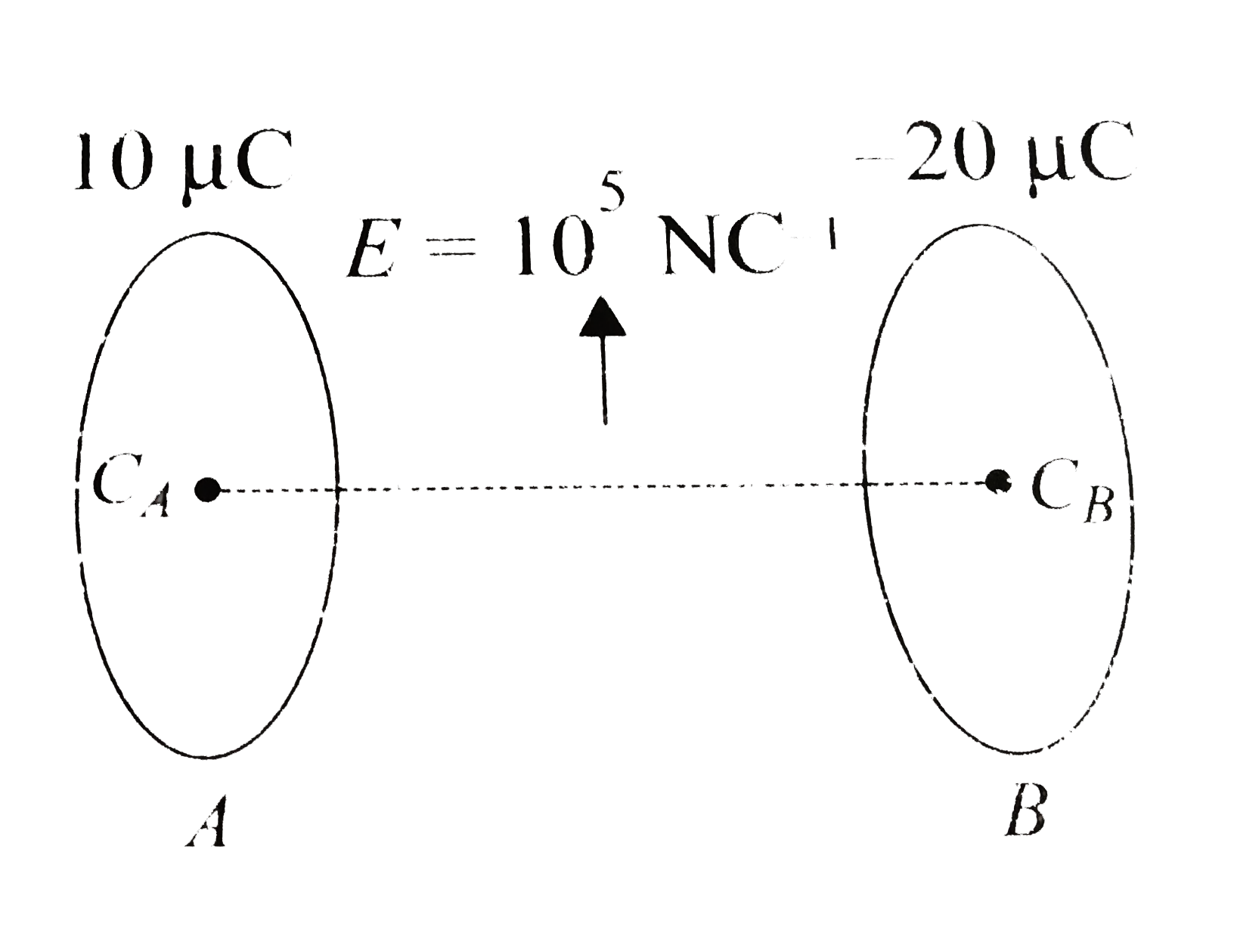
Two circular rings A and B each of radius `a=30cm` are placed co-axially with their axes horizontal in a uniform electric field `E=10^(5)N//C` directed vertically upward as shown in the figure. The distance between the centers of these rings A and B is `h=40cm`. Ring A has a positive charge `q_(1)=10muC` while ring B has a negative charge of magnitude `q_(2)=20muC`. A particle of mass m = 100 gm and carrying a positive charge `q=10muC` is released from rest at the centre of the ring A. Calculate its velocity when it has moved a distance 40 cm.

Text Solution

Verified by Experts

Weight of the particle `W=mg=(100)/(1000)xx10=1` Newton
Force due to electrostatic field `E=qE=10xx10^(-6)xx10^(5)=1` Newton.
Thus the weight of the particle is balanced by the electrostatic force.
The particle experiences net force in the through the centers of ring A and B and is accelerated towards the centre of ring B. At the centre of ring B.
KE = Loss of PE
`implies (1)/(2)mv^(2)=U_(A)-U_(B)=(1)/(4piin_(0))(qq_(1))/(a)+(1)/(4piin_(0))(q(-q_(2)))/(sqrt(a^(2)+h^(2)))-(1)/(4piin_(0))(qq_(1))/(sqrt(a^(2)+h^(2)))-(1)/(4piin_(0))(q(-q_(2)))/(a)`
`(1)/(2)mv^(2)=(q)/(4piin_(0))[q_(1)((1)/(a)-(1)/(sqrt(a^(2)+h^(2))))+q_(2)((1)/(a)-(1)/(sqrt(a^(2)+h^(2))))]`
`=(q)/(4piin_(0))[(q_(1)+q_(2))((sqrt(a^(2)+h^(2))-a)/(asqrt(a^(2)+h^(2))))]`
`implies v=sqrt((2q(q_(1)+q_(2)))/(4piin_(0)m)[(sqrt(a^(2)+h^(2))-a)/(asqrt(a^(2)+h^(2)))])`
For the given value `v=6sqrt(2)m//s`
Promotional Banner

Similar Questions

Explore conceptually related problems

Two circular rings A and B each of radius a = 30 cm are placed coaxially with their axis horizontal in a uniform electric field E = 10^(5) NC^(-1) directed vertically upward as shown in figure. Distance between centers of the rings A and B (C_A and C_B)is 40 cm . Ring A has positive charge q_A = 10muC and B has a negative charge q_B = -20muC . A particle of mass m and charge q = 10muC is released from rest at the center of ring A. If particle moves along C_AC_B, then Speed of particle when it reaches at center of B is

Two circular rings A and B each of radius a = 30 cm are placed coaxially with their axis horizontal in a uniform electric field E = 10^(5) NC^(-1) directed vertically upward as shown in figure. Distance between centers of the rings A and B (C_A and C_B)is 40 cm . Ring A has positive charge q_A = 10muC and B has a negative charge q_B = -20muC . A particle of mass m and charge q = 10muC is released from rest at the center of ring A. If particle moves along C_AC_B, then Work done by electric field, when particle moves from C_A to C_B is

A circular conducting ring of radius 'a' is rolling with slipping on a horizontal surface as shown. A uniform magnetic field B is existing perpendicular to the plane of motion of the ring. The emf iniduced between the points A and D of the ring is

A thin circular wire of radius r has a charge Q. If a point charge q is placed at the centre of the ring, then find the increase in tension in the wire.

A positive charge Q is uniformly distributed along a circular ring of radius R .a small test charge q is placed at the centre of the ring.

A positive charge Q is uniformly distributed along a circular ring of radius R .a small test charge q is placed at the centre of the ring .The

Two thin rings each of radius R are placed at a distance 'd' apart. The charges on the rings are +q and -q. The potential difference between their centres will be -

Positive and negative charges of 1 muC each are placed at two points as shown in the figure. Find the potential difference between A and B

Two identical charges, 5 muC each are fixed at a distance 8 cm and a charged particle of mass 9 xx 10^(-6) kg and charge -10 muC is placed at a distance 5 cm from each of them and is released. Find the speed of the particle when it is nearest to the two charges.

A regular hexagon of side 10 cm has a charge 5 muC at each of its vertices. Calculate the potential at the center of the hexagon.
