Home
Class 12
PHYSICS
Point charges +q and -q are kept alterna...

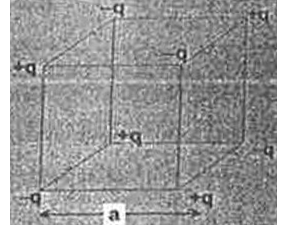
Point charges `+q and -q` are kept alternately at the corners of a cube of side 'a' as shown in the figure. Write an expression for the work done in removing all the charges far away from each other.

Text Solution

Verified by Experts

Required work done = - (Initial potential energy of the system)
`-[12((q)(-q))/(4piepsilon_(0)(a))+6((q)(q))/(4piepsilon_(0)(sqrt(2)a))+6((-q)(-q))/(4piepsilon_(0)(sqrt(2)a))+4((q)(-q))/(4piepsilon_(0)(sqrt(3)a))]`
`=(q^(2))/(4piepsilon_(0)a)(12-6sqrt(2)+(4)/(sqrt(3)))`
Promotional Banner

Similar Questions

Explore conceptually related problems

Charges +q and -q are located at the corners of a cube of side as show in the figure. Find the work done to separate the charges to infinite distance

Four point charges Q, q, Q and q are placed at the corners of a square of side' a' as shown in the figure. Find the . (a) resultnat electric force on a charge Q and . (b) potential energy of this system.

(a) Three point charges q,-4q and 2q are placed at the vertices of an equilateral triangle ABC of side 'l' as shown in the figure. Obtain the expression for the magnitude of the resultant electric force acting on the charge q. (b) Find out the amount of the work 4one to separate the charges at infinite distance.

Four point charges +q,+q,-q and -q are placed on the corners of a square of side length 'a' as shown in the figure. The magnitude of electric field at a point which is at a distance x (gt gt a) from the centre along a line perpendicular to the plane of the square and passing through the centre is

Five point charges each of charge +q are placed on five vertices of a regular hexagon of side h as shown in the figure. Then

Four charges of +q, +q, +q and +q are placed at the corners A, B, C and D of a square of side a. Find the resultant force on the charge at D

Point charges each of magnitude Q are placed at three corners of a square as shown in the diagram. What is the direction of the resultant electric field at the fourth corner ?

A charge Q is placed at each corner of a cube of side a. The potential at the centre of the cube is

Six charge of magnitude +q and -q are fixed at the corners of a regular hexagon of edge length a as shown in the figure .The electrostatic interaction energy of the charged particle is :

The work done to move a unit charge along an equipotential from P to Q
