Home
Class 12
PHYSICS
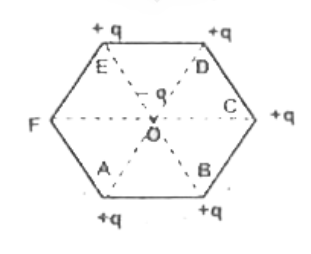
Five point charges each of charge +q are...

Five point charges each of charge +q are placed on five vertices of a regular hexagon of side h as shown in the figure. Then

A

the forces on (-q) at O due to charges +q at A and D are balanced

B

the force on (-q) due to charges at D and E are balanced

C

the resultant forces on -q at O is `(q)/(4piepsilon_(0))(q^(2))/(h^(2))` along OE

D

The resultant force on -q at O is `(q)/(4piepsilon_(0))(q^(2))/(h^(2))` along OC.

Text Solution

Verified by Experts

The correct Answer is:

A, D
Promotional Banner

Similar Questions

Explore conceptually related problems

Five point charges, each of value +q coulomb, are placed on five vertices of a regular hexagon of side L meters. The magnitude of the force on the point charge of value -q coulomb, placed at the centre of the hexagon is…………….

Five point charges, each of value +q coul, are placed on five vertices of a regular hexagon of isde L meters. The magnitude of the force on the point charge of value -q coul, placed at the centre of the hexagen is…………….

Five point charge ( +q each) are placed at the five vertices of a regular hexagon of side 2a .what is the magnitude of the net electric field at the centre of the hexazon?

Six point charges are kept at the vertices of a regular hexagon of side L and centre O, as shown in the figure. Given that K=(1)/(4piepsilon_0)(q)/(L^2) , which of the following statements(s) is (are) correct?

Six point charges are arrange at the vertices of a regular hexagon of side length a (shown in figure). Find the magnitude of electric field at the centre of regular hexagon.

Three charges Q, (+q) and (+q) are placed at the vertices of an equilateral triangle of side l as shown in the figure. It the net electrostatic energy of the system is zero, then Q is equal to

Three charges Q, (+q) and (+q) are placed at the vertices of an equilateral triangle of side l as shown in the figure. It the net electrostatic energy of the system is zero, then Q is equal to

(a) Three point charges q,-4q and 2q are placed at the vertices of an equilateral triangle ABC of side 'l' as shown in the figure. Obtain the expression for the magnitude of the resultant electric force acting on the charge q. (b) Find out the amount of the work 4one to separate the charges at infinite distance.

Four point masses easch of mass 'm' are placed at four vertieces A, B, C, nd D of a regular hexagon of side 'a' as shown in figure , Find gravitational potential and field strength at the centre O of the hexagon. .

Three point charges each of value + q are placed on three vertices of a square of side a metre. What is the magnitude of the force on a point charge of value -q coulomb placed at the centre of the square?
