Home
Class 12
PHYSICS
An accelration produces a narrow beam of...

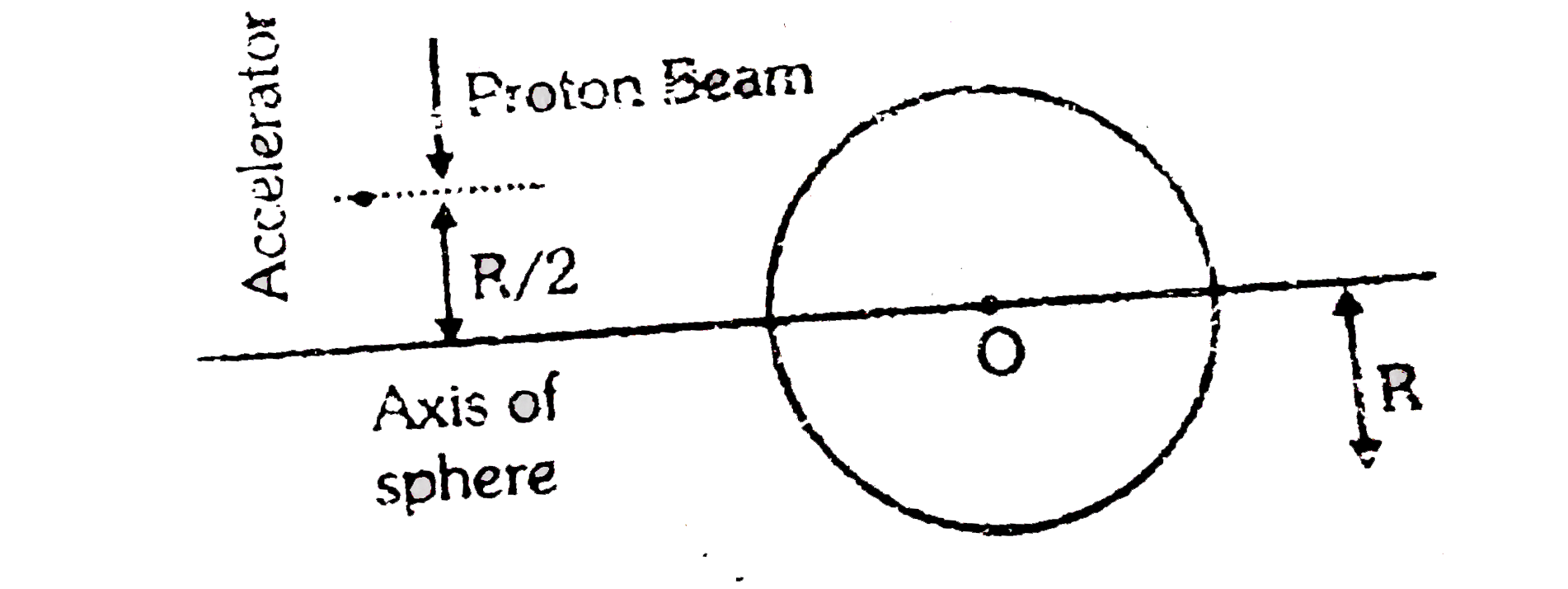
An accelration produces a narrow beam of protons, each having an initial speed of `v_(0)`. The beam is directed towards an initially uncharges distant metal sphere of radius R and centered at point O. The initial path of the beam is parallel to the axis of the sphere at a distance of `(R//2)` from the axis, as indicated in the diagram.

The protons in the beam that collide with the sphere will cause it to becomes charged. The subsequentpotential field at the accelerator due to the sphere can be neglected. The angular momentum of a particle is defined in a similar way to the moment of a force. It is defined as the moment of its linear momentum, linear replacing the force. We may assume the angular momentum of a proton about point O to be conserved. Assume the mass of the proton as `m_(P)` and the charge on it as e. Given that the potential of the sphere increases with time and eventually reaches a constant velue.
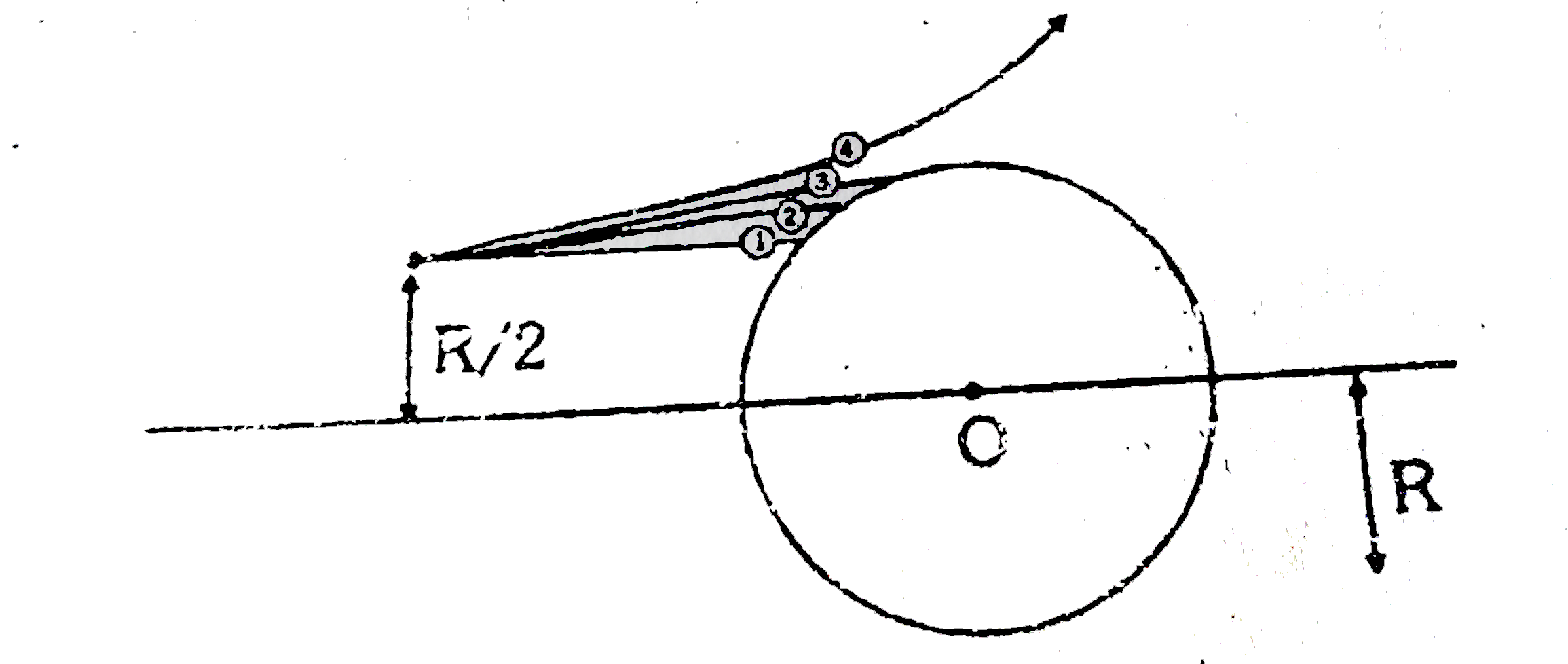
After a long time, when the potential of the sphere reaches a constant value, the trajectory of proton is correctly sketched as

A

1

B

2

C

3

D

4

Text Solution

Verified by Experts

The correct Answer is:

D
Promotional Banner

Similar Questions

Explore conceptually related problems

An accelration produces a narrow beam of protons, each having an initial speed of v_(0) . The beam is directed towards an initially uncharges distant metal sphere of radius R and centered at point O. The initial path of the beam is parallel to the axis of the sphere at a distance of (R//2) from the axis, as indicated in the diagram. The protons in the beam that collide with the sphere will cause it to becomes charged. The subsequentpotential field at the accelerator due to the sphere can be neglected. The angular momentum of a particle is defined in a similar way to the moment of a force. It is defined as the moment of its linear momentum, linear replacing the force. We may assume the angular momentum of a proton about point O to be conserved. Assume the mass of the proton as m_(P) and the charge on it as e. Given that the potential of the sphere increases with time and eventually reaches a constant velue. The limiting electric potential of the sphere is

An accelration produces a narrow beam of protons, each having an initial speed of v_(0) . The beam is directed towards an initially uncharges distant metal sphere of radius R and centered at point O. The initial path of the beam is parallel to the axis of the sphere at a distance of (R//2) from the axis, as indicated in the diagram. The protons in the beam that collide with the sphere will cause it to becomes charged. The subsequentpotential field at the accelerator due to the sphere can be neglected. The angular momentum of a particle is defined in a similar way to the moment of a force. It is defined as the moment of its linear momentum, linear replacing the force. We may assume the angular momentum of a proton about point O to be conserved. Assume the mass of the proton as m_(P) and the charge on it as e. Given that the potential of the sphere increases with time and eventually reaches a constant velue. The total energy (E) of a proton in the beam travelling with seed v at a distance of r (r ge R) from point O. Assuming that the sphere has acquired an electrostatic charge Q is

A light beam of diameter sqrt(3R) is incident symmetrically on a glass hemisphere of radius R and of refractive index n=sqrt(3) . Find radius of the beam at the base of hemisphere.

A light beam of diameter sqrt(3R) is incident symmetrically on a glass hemispher of radius R and of refractive index n=sqrt(3) . Find radius of the beam at the base of hemispher.

A point charge q is placed at a distance of r from cebtre of an uncharged conducting sphere of rad R(lt r) . The potential at any point on the sphere is

A horizontal ray of light is incident on a solid glass sphere of radius R and refractive index mu . What is net deviation of the beam when it emerged from the other side of the sphere?

A parallel beam of light emerges from the opposite surface of the sphere when a point source of light lies at the surface of the sphere. The refractive index of the sphere is

The radius of gyration of a solid sphere of radius R about a certain axis is also equal to R. If r is the distance between the axis and the centre of the sphere, then r is equal to

A parallel incident beam falls on a solid glass sphere at normal incidenc. Prove that the distance of the fianll image after two refractions is at a distance (2-mu)//2(mu-1)a from the outer edge of the sphere. Refractive index of the sphere is mu and radius of the sphere is a.

When a thin metal plate is placed in the path of one of the interfering beams of light
