Home
Class 12
PHYSICS
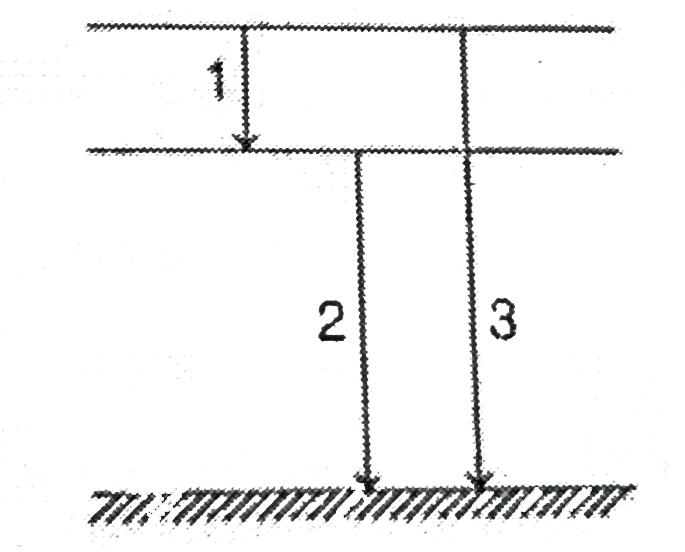
The wavelength and frequncies of photons...

The wavelength and frequncies of photons in transitions 1.2 and 3 for hydrogen like atom are `lambda_(1),lambda_(2),`lambda_(3),v_(1),v_(2)` and `v_(3)` respectively Then.

A

`v_(3)=v_(1)+v_(2)`

B

`v_(3)=(v_(1)v_(2))/(v_(1)+v_(2))`

C

`lambda_(3)=lambda_(1)+lambda_(2)`

D

`lambda_(3)=(lambda_(1)lambda_(2))/(lambda_(1)+lambda_(2))`

Text Solution

Verified by Experts

The correct Answer is:

A, D
Promotional Banner

Similar Questions

Explore conceptually related problems

The wavelengths and frequencies of photons in transition 1,2 and 3 for hydrogen like atom are lambda_(1),lambda_(2),lambda_(3), v_(1),v_(2) and v_(3) respectively. Then:

Hydrogen (_(1)H^(1)) Deuterium (_(1)H^(2)) singly omised helium (_(1)He^(1)) and doubly ionised lithium (_(1)Li^(6))^(++) all have one electron around the nucleus Consider an electron transition from n = 2 to n = 1 if the wavelength of emitted radiartion are lambda_(1),lambda_(2), lambda_(3),and lambda_(4) , repectivelly then approximetely which one of the following is correct ?

The wavelengths of photons emitted by electron transition between two similar leveis in H and He^(+) are lambda_(1) and lambda_(2) respectively. Then :-

The wavelengths of photons emitted by electron transition between two similar leveis in H and He^(+) are lambda_(1) and lambda_(2) respectively. Then :-

The wavelength of the short radio waves, microwaves, ultraviolet waves are lambda_(1),lambda_(2) and lambda_(3) , respectively, Arrange them in decreasing order.

A wave enters to water from air. In air frequency, wavelength, intensity and velocity n_(1),lambda_(1),I_(1) and v_(1) respectively.In water the corresponding quantities are n_(2),lambda_(2),I_(2) and v_(2) respectively, then

If the points A(lambda, 2lambda), B(3lambda,3lambda) and C(3,1) are collinear, then lambda=

Cut off potential for a metal in photoclectric effect for light of wavelength lambda_(1), lambda_(2) and lambda_(3) is found to be V_(1),V_(2) and V_(3) volts , If V_(1),V_(2) and V_(3 are in Arithmetic progression then lambda_(1),lambda_(2) and lambda_(3) will be in

A particle moving with kinetic energy E_(1) has de Broglie wavelength lambda_(1) . Another particle of same mass having kinetic energy E_(2) has de Broglie wavelength lambda_(2). lambda_(2)= 3 lambda_(2) . Then E_(2) - E_(1) is equal to

A particle moving with kinetic energy E_(1) has de Broglie wavelength lambda_(1) . Another particle of same mass having kinetic energy E_(2) has de Broglie wavelength lambda_(2). lambda_(2)= 3 lambda_(2) . Then E_(2) - E_(1) is equal to
