Home
Class 12
PHYSICS
A particle of mass m at rest is acted up...

A particle of mass m at rest is acted upon by a constant force F for a time t. Its kinetic energy after an interval t is

Text Solution

Verified by Experts

The correct Answer is:
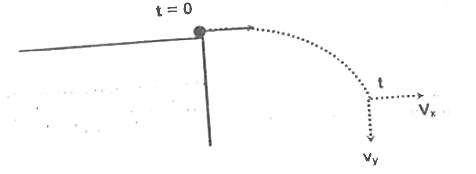
2

`k=(1)/(2) mv_(x)^(2)`
`3k=(1)/(2)m(v_(x)^(2)+v _(y)^(2))`
`v_(x)^(2)+v_(y)^(2)=3v_(x)^(2)`
`2v_(x)^(@)=vy^(2)impliesv_(y)=sqrt(2v_(x))`
`V_(y)=V_(y)+a_(y)t`
`sqrt(2v_x)=0+gtimpliest=(sqrt(2v_x))/(g)`
`(sqrt(2v_x))/(g)=(n)/(g)sqrt((1/2mv_(x)^(2))/(m)`
`2v^(2)+(n^2v_(x)^(2))/(2)impliesn=2`
Promotional Banner

Similar Questions

Explore conceptually related problems

A block of mass m at rest is acted upon by a force F for a time t. The kinetic energy of block after time t is

Two bodies of masses m_(1) and m_(2) are acted upon by a constant force F for a time t . They start from rest and acquire kinetic energies K_(1) and K_(2) respectively. Then (K_(1))/(K_(2)) is :

A particle of mass m initially at rest is acted upon by a unidirectional force F=F_@cos ((pi)/(2) t) . The distance travelled by the particle when it stops first in the subsequent motion is ,

A particle of mass m is acted upon by a force F= t^2-kx . Initially , the particle is at rest at the origin. Then

A particle of mass 70 g, moving at 50 cm/s , is acted upon by a variable force opposite to its direction of motion. The force F is shown as a function of time t (a) its speed will be 50 cm/s after the force stops acting (b) its direction of motion will reverse (c) its average acceleration will be 1 m//s^2 during the interval in which the force acts its average acceleration will be 10 m//s^2 during the interval in which the force acts

The velocity vecv of a particle of mass 'm' acted upon by a constant force is given by vecv (t) = A[cos (kt) bari - sin (kt) barj] . Then the angle between the force and the momentum of the particle is (Here A and k are constants)

A particle of mass 120 g moving at speed of 750 cm/s is acted upon by a variable force opposite to its direction of motion. If the velocity of the particle becomes 250 cm/s along the direction of force, find the value of time 't' for which acted.

A particle of mass m is acted upon by a force F given by the emprical law F=(R)/(t^2)upsilon(t) If this law is to be tested experimentally by observing the motion starting from rest, the best way is to plot :

A particle of mass m moves from rest under the action of a constant force F which acts for two seconds. The maximum power attained is

A particle of mass m and charge q is placed at rest in a uniform electric field E and then released, the kinetic energy attained by the particle after moving a distance y will be

