Home
Class 12
PHYSICS
A car accelerates from rest at constant ...

A car accelerates from rest at constant rate of `2ms^(-2)` for some time. Immediately after this, it retards at a constant rate of `4ms^(-2)` and comes to rest. The total time for which it remains in motion is 3 s. Taking the moment of start of motion as t = 0, answer the following questions.
What is the maximum speed attained by the car ?

Text Solution

Verified by Experts
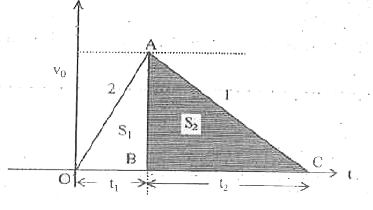
The area of v-t graph gives the displacement. Since the car moves in one direction, its total distance covered will be numerically equal to its displacement
S = 100 m (given)
`s=(1)/(2)(OB)(AB)+(1)/(2)(BC)(AB)``=(1)/(2)(t_(1)+t_(2))v_(0)`  where`v_(0)=maximum`
speed of the car
`(t_(1)+t_(2))`= T = 20 sec and s = 100 m
`rArr`  100 =`(1)/(2)(20)v_(0)rArrv_(0)=10m//sec`
Promotional Banner

Similar Questions

Explore conceptually related problems

A car accelerates from rest at constant rate of 2ms^(-2) for some time. Immediately after this, it retards at a constant rate of 4ms^(-2) and comes to rest. The total time for which it remains in motion is 3 s. Taking the moment of start of motion as t = 0, answer the following questions. What is the average speed of the car for the journey . a. 2 m/s b. 3 m/s c. 1 m/s d. Zero

A car accelerates from rest at constant rate of 2ms^(-2) for some time. Immediately after this, it retards at a constant rate of 4ms^(-2) and comes to rest. The total time for which it remains in motion is 3 s. Taking the moment of start of motion as t = 0, answer the following questions. What is the distance travelled by it during the time of increasing speed ?

A car accelerates from rest at constant rate of 2ms^(-2) for some time. Immediately after this, it retards at a constant rate of 4ms^(-2) and comes to rest. The total time for which it remains in motion is 3 s. Taking the moment of start of motion as t = 0, answer the following questions. What is the distance travelled by it during the time of decreasing speed ?

A car accelerates from rest at constant rate of 2ms^(-2) for some time. Immediately after this, it retards at a constant rate of 4ms^(-2) and comes to rest. The total time for which it remains in motion is 3 s. Taking the moment of start of motion as t = 0, answer the following questions. At t = 3 s, the speed of the car is zero. The time for which it increases its speed is

A car accelerates from rest at constant rate of 2ms^(-2) for some time. Immediately after this, it retards at a constant rate of 4ms^(-2) and comes to rest. The total time for which it remains in motion is 3 s. Taking the moment of start of motion as t = 0, answer the following questions. If the time of acceleration is t_(1) , then the speed of the car at t=t_(1) is

A car accelerates from rest at constant rate of 2ms^(-2) for some time. Immediately after this, it retards at a constant rate of 4ms^(-2) and comes to rest. The total time for which it remains in motion is 3 s. Taking the moment of start of motion as t = 0, answer the following questions. Let t be a time instant greater than t_(1) but less than 3 s. The velocity at this time instant is

A car accelerates from rest at a constant rate of 2ms^(-2) for some time. Then, it retards at a constant rete of 4ms^(-2) and comes and rest. If the total time for which it remains in motion is 3 s, Then the total distance travelled is

A car accelerates from rest at a constant rate of 2 m s^(-2) for some time. The it retatds at a constant rate of 4 m s^(-2) and comes to rest. It remains in motion for 6 s .

A car acceleration from rest at a constant rate 2m//s^(2) for some time. Then, it retards at a constant rate of 4 m//s^(2) and comes to rest. If it remains motion for 3 second, then the maximum speed attained by the car is:-

A train accelerates from rest at a constant rate a for time t_(1) and then it retards at the constant rate b for time t_(2) then comes to rest. Find the ratio t_(1) / t_(2) .

