Home
Class 12
PHYSICS
A ball of mass m is attached to one end ...

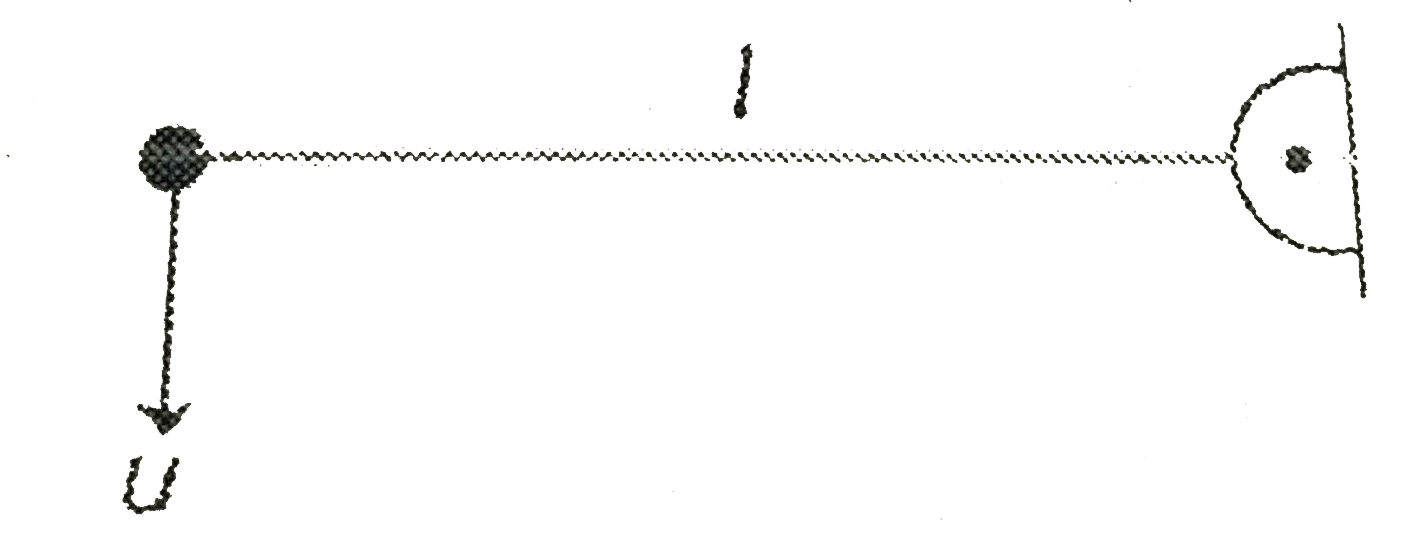
A ball of mass `m` is attached to one end of a light rod of length `l`, the other end of which is hinged. What minimum velocity `v` should be imparted to the ball downwards, so that it can complete the circle ?

A

`sqrt(g varphi)`

B

`sqrt(5g varphi)`

C

`sqrt(3g varphi)`

D

`sqrt(2g varphi)`

Text Solution

Verified by Experts

The correct Answer is:

D
Promotional Banner

Similar Questions

Explore conceptually related problems

A particle of mass of mass m is attached to a light rod of lenght l other end of the rod is hinged to a wall . Minimumm velocity (Vo) that should be given to a particle in lowest positiion so that it completes a vertical circle

A particle of maas m is attched to a light string of length l, the other end of which is fixed. Initially the string is kept horizontal and the particle is given an upwrd velocity v. The particle is just able to complete a circle

A particle of mass m is fixed to one end of a light rigid rod of length l and rotated in a vertical ciorcular path about its other end. The minimum speed of the particle at its highest point must be

A light rod of length l is pivoted at the upper end. Two masses (each m), are attached to the rod, one at the middle and the other at the free end. What horizontal velocity must be imparted to the lower end mass, so that the rod may just take up the horizontal position ?

A ball with mass m is attached to the end of a rod of mass M and length l . The other end of the rod is pivoted so that the ball can move in a vartical circle. The rod is held in the horizontal position as shown in figure and then given just enough a downward push so that the ball swings down and just reaches the vertical upward position having zero speed there. Now answer the following questions. The change in potential energy of the system (ball+rod) is

A ball with mass m is attached to the end of a rod of mass M and length l . The other end of the rod is pivoted so that the ball can move in a vartical circle. The rod is held in the horizontal position as shown in figure and then given just enough a downward push so that the ball swings down and just reaches the vertical upward position having zero speed there. Now answer the following questions. The initial speed given to the ball is

One end of a light rod of length 1m is attached with a string of length 1m. Other end of the rod is attached at point O such that rod can move in a vertical circle. Other end of the string is attached with a block of mass 2kg. The minimum velocity that must be given to the block in horizontal direction so that it can complete the vertical is (g=10 m//s^(2))

A particle is rotated in a verticle circle by connecting it to the end of massless rod of length l and keeping the other end of rod fixed. The minimum speed of the particle when the rod is horizontal for which the particle will complete the circle is

Two point masses m are connected the light rod of length l and it is free to rotate in vertical plane as shown in figure. Calculate the minimum horizontal velocity is given to mass so that it completes the circular motion in vertical lane.

A sphere is suspended by a thread of length l. What minimum horizontal velocity has to be imparted to the ball for it to reach the height of the suspension?
