Home
Class 12
PHYSICS
A particle moving parallel to x-axis as ...

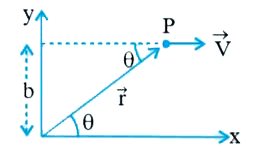
A particle moving parallel to x-axis as shown in figure. such that, at all instant the y-axis component of its position vector is constant and is equal to ‘b’. Find the angular velocity of the particle about the origin.

A

`(v)/(b)`

B

`(v)/(b)sin theta`

C

`(v)/(b)sin^(2) theta`

D

vb

Text Solution

Verified by Experts

The correct Answer is:

C
Promotional Banner

Similar Questions

Explore conceptually related problems

A particle moving parallel to x-axis as shown in fig. such that at all instant the y-axis component of its position vector is constant and is equal to 'b'. Find the angular velocity of the particle about the origin when its radius vector makes angle theta from the axis.

A particle is moving parallel to x-axis as shown in the figure. The angular velocity of the particle about the origin is

A particle mass parallel to x-axis with constant velocity v as shown in the figure. The angular velocity of the particle about the origin O

A particle is moving in x-y plane as shown in the figure. Angular velocity of the particle with respect to the origin is

Velocity of particle parallel to y - axis is

A particle of mass m is moving with constant velocity v parallel to the x-axis as shown in the figure. Its angular momentum about origin O is

A particle moves in the plane xy with constant acceleration 'a' directed along the negative y-axis. The equation of motion of the particle has the form y= px - qx^2 where p and q are positive constants. Find the velocity of the particle at the origin of co-ordinates.

A particle moves in the plane xy with constant acceleration 'a' directed along the negative y-axis. The equation of motion of the particle has the form y= px - qx^2 where p and q are positive constants. Find the velocity of the particle at the origin of co-ordinates.

A particle has a linear momentum p and position vector r. the angular momentum of this particle about the origin will not be zero under the conditions

Force acting on a particle moving along x-axis as shown in figure. Find points of stable and unstable equlibrium. .
