Home
Class 12
PHYSICS
An ideal massless spring S can compresse...

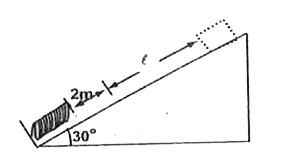
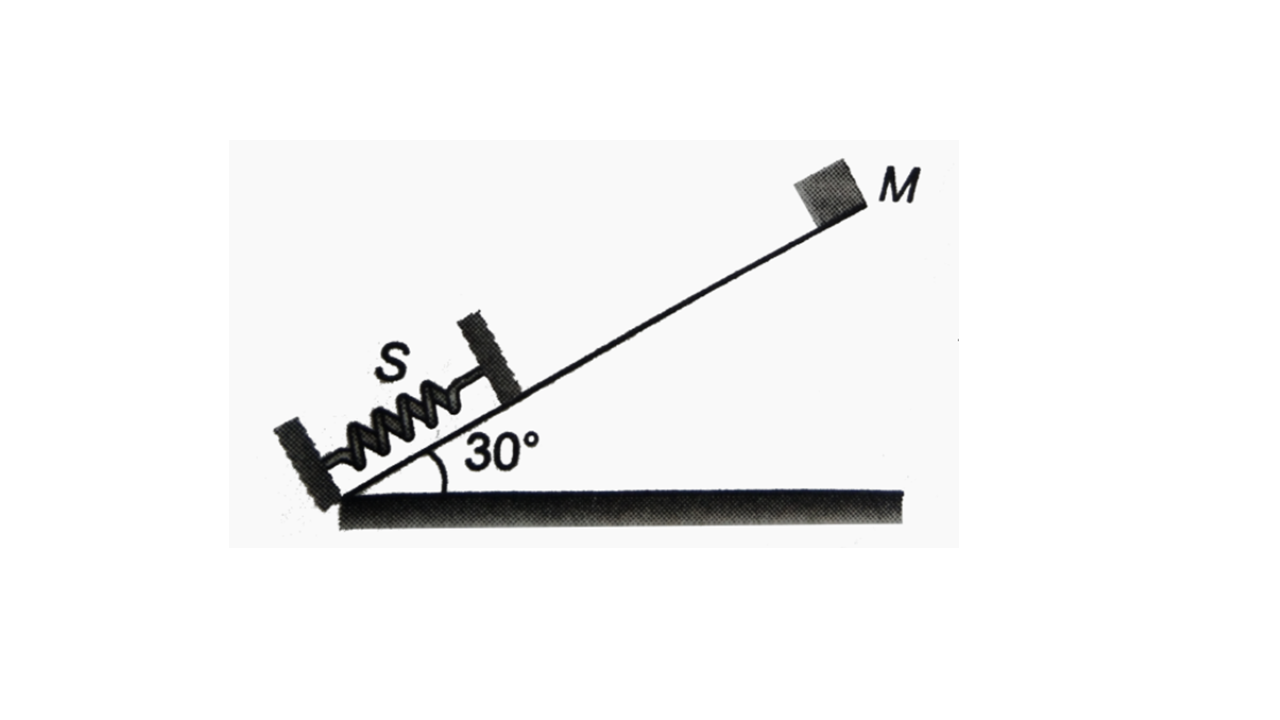
An ideal massless spring `S` can compressed `1.0` m in equilibrium by a force of `100 N`. This same spring is placed at the bottom of a friction less inclined plane which makes an angle `theta =30^@` with the horizontal. A (10 kg) mass (m) is released from rest at the top of the incline and and is brought to rest momentarily after compressing the spring by `2 m. if `g =10 ms^(-1)`, what is the speed of just before it touches the spring? .

Text Solution

Verified by Experts

(a) Let total distance moved by the block is
`S=(l+2)m`,
where `l` is the distance moved by the block before touching the spring.
Now, work done by gravity on the block is
`W_(g)=mg S " " sin theta = 10 xx 10 xx S sin 30J`
`rArr W_(g)=50 S J ` ...(1)
Work done by spring on the block is , `W_(s)=1/2 kx^(2)`
Here, `K=100N//m` and `x=2m`
`rArr W_(s)=1/2xx 100 xx 4J rArr W_(s)=200 J` ...(2)
Total work done `W=W_(g)+W_(s)`
`rArr W=(50 S-200)J`
Since change in K.E. of the block is zero.
as `W=DeltaK.E.`
`rArr 50 S-200=0`
`rArr S=4m`

(b) As `S=l+2 rArr l=S-2=2m`
Work done by gravity over this path length is
`W_(g)=mgxx2 sin theta = 10 xx 10 xx 2 xx 1/2=100J " " [ :.W_(g)=DeltaK.E.]`
`rArr 100 = 1/2 mv^(2)-0 rArr v^(2)=(100xx2)/(10)=20`
`rArr v=2sqrt(5)m//s`
Promotional Banner

Similar Questions

Explore conceptually related problems

An ideal massless spring S can compressed 1.0 m in equilibrium by a force of 1000 N . This same spring is placed at the bottom of a friction less inclined plane which makes an angle theta =30^@ with the horizontal. A 10 kg mass m is released from the rest at top of the inclined plane and is brought to rest momentarily after compressing the spring by 2.0 m. the distance through which the mass moved before coming to rest is.

An ideal massles spring S can be compressed 1 m by a force of 100 N in equilibrium. The same spring is placed at the bottom of a frictionless plane inclined at 30^(@) to the horizontal. A 10 kg block M is released from rest at the top of the incline and is brought to rest momentarily after compressing the spring by 2 m. If g = 10 m//s^(2) , the speed of mass just before it touches the spring is sqrt(10x) m//s . Find value of x?

A block of mass 2 kg rests on a rough inclined plane making an angle of 30° with the horizontal. If mu_(S)= 0.6 , what is the frictional force on the block ?

A block of mass sqrt2 kg is released from the top of an inclined smooth surface as shown in fighre. If spring constant of spring is 100 N/m and block comes to rest after compressing the spring by 1 m, then the distance travelled by block befor it comes to rest is

A block of mass sqrt2 kg is released from the top of an inclined smooth surface as shown in fighre. If spring constant of spring is 100 N/m and block comes to rest after compressing the spring by 1 m, then the distance travelled by block befor it comes to rest is

In an ideal pulley particle system, mass m_2 is connected with a vertical spring of stiffness k . If mass m_2 is released from rest, when the spring is underformed, find the maximum compression of the spring.

A block of 4kg mass starts at rest and slides a distance d down a friction less incline ( angle 30^@ ) where it runs into a spring of negligible mass. The block slides an additional 25cm before it is brought to rest momentarily by compressing the spring. The force constant of the spring is 400Nm^-1 . The value of d is (take g=10ms^-2 )

A block rests on a rough inclined plane making an angle of 30^(@) with horizontal. The coefficient of static friction between the block and inclined plane is 0.8 . If the frictional force on the block is 10 N , the mass of the block in kg is (g = 10 m//s^(2))

The upper half of an inclined plane with an angle of inclination theta, is smooth while the lower half is rough. A body starting from rest at the top of the inclined plane comes to rest at the bottom of the inclined plane. Then the coefficient of friction for the lower half is