Home
Class 12
PHYSICS
The block of mass M in figure -4.160, in...

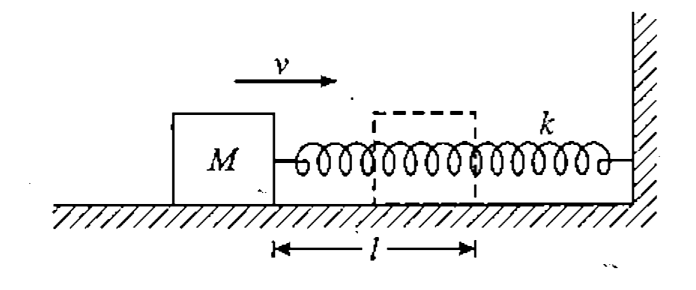
The block of mass M in figure `-4.160,` initially has a velocity `v_(o)` to the right and its positionis much that the spring exerts no froce on it, i.e, the spring is not stretched or comkpressed. The block moves to the right a distance l before sttoping in the dotted position shown. The speing constant is k and the coefficeent of kinetic friction between block and table is `mu.` as the block moves the distance l, (a) what is the work done on it by the friction force ? (b) What is the work done on it by the spring force ? (c) are there other forces actionon the block, and if so what work do they do ? (d) what is the total work done on the block?

Text Solution

Verified by Experts
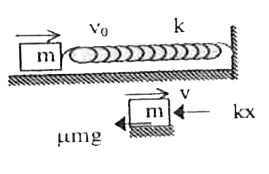
(a) The net force acting on the block by the spring is equal to `F_("spring")=kx`
Work done by the spring `= int vec(F)_("spring").d vec(s)`
`= int F_("spring") ds cos 180^(@)=- int F_("spring").ds`
`= - int_(0)^(l)kxdx=(-kl^(2))/(2)`

(b) The total work done `W=Delta KE=0-(1/2)mv_(0)^(2)=-(1/2)mv_(0)^(2)`.
(c) The work done by friction `= - mu mgl`
`rArr ` The total work done `W_(s)+W_(f)=DeltaKE=- mu mgl-(1//2)kl^(2)=-(1/2)mv_(0)^(2)`
`rArr 1/2 kl^(2)+mu mgl=1/2 mv_(0)^(2)`
`rArr l=(mu mg)/(k) [ sqrt(1+k/m ((v_(0))/(mu g))^(2))-1]`
Promotional Banner

Similar Questions

Explore conceptually related problems

A block of mass m slides in right angled incliine through as shown in the figure . If the coefficient of kinetic friction between the block and the through is mu_(k) , find the acceleration of the block .

A block of mass m is moving on a rough horizontal surface. mu is the coefficient of kinetic friction between the block and the surface. What is the net force exerted by the surface on the block?

A block of mass m sides down an inclined right angled trough .If the coefficient of friction between block and the trough is mu_(k) acceleration of the block down the plane is

A block of mass m has initial velocity u having direction towards +x axis. The block stops after covering a distnce S causing similar extension in the spring of constant K holding it. If mu is the kinetic friction between the block and the surface on which it was moving, the distance S is given

A block of mass m moving at a speed v compresses a spring throgh a distance x before its speed is halved. Find the spring constant of the spring.

A block of mass m moving at a speed 'v' compresses as spring through a distance 'x' before its speed is halved. Find the spring constant of the spring.

A block of mass m is pressed against a wall by a spring as shown in the figure. The spring has natural length , l (l gt L) , and the coefficient of friction between the block and the wall is mu . The minimum spring constant K necessary for equilibrium is:

A block of mass m is connected with a rigid wall by light spring of stiffness k . Initially the spring is relaxed. If the block is pushed with a velocity v_0 , it oscillates back and forth and stops. Assuming mu as the coefficient of kinetic friction between block and ground, find the work done by friction till the block stops.

In the system as shown in figure, the blocks have masses m_(1) and m_(2) , the spring constant is k, coefficient of friction between the block of mass m_(1) and the surface is mu . The system is released with zero initial speed from the position where the spring is in its natural length.

A block of mass m moving with velocity v_(0) on a smooth horizontal surface hits the spring of constant k as shown. The maximum compression in spring is

