Home
Class 12
PHYSICS
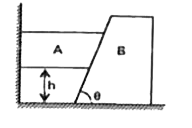
Two smooth wedges of equal mass m are pl...

Two smooth wedges of equal mass m are placed as shown in figure. All surfaces are smooth. Find the velocities of A & B when A hits the ground.

Text Solution

Verified by Experts

`mgh=1/2 m(v_(B))^(2)+1/2 mv_(A)^(2)` ... (1)
`:.y//x=tan theta`
`rArr y=x tan theta`
`v_(A)=v_(B)tan theta` ...(2)
Putting value `v_(A)` in equation (1) and solving we get
`v_(A)=sqrt(2gh)sin theta, v_(B)=sqrt(2gh)cos theta`
Promotional Banner

Similar Questions

Explore conceptually related problems

A block of mass 1 kg is moving towards a movable wedge of mass 2 kg as shown in figure. All surfaces are smooth. When the block leaves the wedge from top, its velocity is making an angle theta =30^(@) with horizontal. The value of v_(0) in m/s is

A block of mass m is placed on a wedge of mass M and a force F is acting on its as shown . If all surfaces are smooth , find the force F such that, there is no relative motion between m and M.

In fig. mass m is being pulled on the incline of a wedge of mass M. All the surfaces are smooth. Find the acceleration of the wedge.

A block of mass m is placed on a triangular block of mass M(M = 2m) , as shown. All surfaces are smooth. Calculate the velocity of triangular block when the smaller block reaches at bottom.

In the figure shown A and B are free to move . All the surface are smooth. Mass of A is m . Then

A wedge of mass M lies on a smooth fixed wedge of inclination theta . A particle of mass m lies on the wedge of mass M in the figure. All surfaces are frictionless and the distance of the block from the fixed wedge is l . Find. (a) Normal reaction between m and M (b) the time after which the particle will hit the fixed plane.

A smooth block of mass m is held stationary on a smooth wedge of mass M and inclination theta as shown in figure .If the system is released from rest , then the normal reaction between the block and the wedge is

A rigid uniform rod of mass M and length L is placed along the Y-axis on a smooth horizontal surface with its centre at the origin. Two particles , each of mas m ( = M //12) hits simultaneously , at the two ends with equal speed v as shown in the figure. The collision is completely inelastic. (i) Find the angular velocity of the system after the collision. (ii) Two particles of mass 2m and m are placed respectively at ( L//2, 0) and ( - L//2, 0) . Calculate the time when the rod hits these particles.

A block of mass m is pushed towards a movable wedge of mass nm and height h , with a velocity u . All surfaces are smooth. The minimum value of u for which the block will reach the top of the wedge is

A sphere of mass m held at a height 2R between a wedge of same m and a rigid wall, is released from, Assuming that all the surfaces are frictionless. Find the speed of the bodies when the sphere hits the ground. .
