Home
Class 12
PHYSICS
What is the power required to push the w...

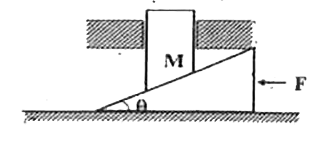
What is the power required to push the woodn wedge horizontally with constant speed `v_(0)` to raise the heavy block M, as shown in the figure. All surfaces are frictionless.

Text Solution

Verified by Experts
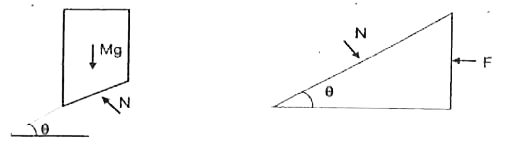
Since the wedge moves with uniform velocity, therefore, it is in equilibrium
`:.N cos theta= Mg`
and `N sin theta = F`
thus, `F=Mg tan theta `
The required power is `P=Fv_(0)=Mgv_(0)tan theta`
Promotional Banner

Similar Questions

Explore conceptually related problems

Find the acceleration of the block of mass M in the situation shown in figure. All the surfaces are frictionless.

Find the acceleration of the block of mass M in the situation shown in figure. All the surfaces are frictionless.

Refer the system shown in the figure. Block is siding down the wedge. All surfaces are frictionless. Find correct statement (s)

A small block of mass m=2kg is at rest point P of the stationary wedge having frictionless hemispherical track of radius R=4m . The minimum constant acceleration 'a_(0)' ( in m//s^(2) ) is to be given to the wedge in horizontal direction, so that the small block just reaches the point Q as shown in figure. Assume all the contacts are frictionless and g=10m//s^(2) . If a_(0)=2xm//s^(2) . Find the value of x

A wedge of mass M lies on a smooth fixed wedge of inclination theta . A particle of mass m lies on the wedge of mass M in the figure. All surfaces are frictionless and the distance of the block from the fixed wedge is l . Find. (a) Normal reaction between m and M (b) the time after which the particle will hit the fixed plane.

Assuming all the surfaces to be frictionless accelration of the block c shown in the figure is

Figure shows a small block of mass m which is started with a speed v on the horizontal part of the bigger block of mas m placed on a horizontal floor. The curved part of the surface shown is semicircular. All the surfaces are frictionless. Find the speed of the bigger block when the smaller block reaches the point A of the surface.

A block of mass m is placed on the inclined sufrace of a wedge as shown in fig. Calculate the acceleration of the wedge and the block when the block is released. Assume all surfaces are frictionless.

find the acceleration of the block of mass M in the situation shown in figure. All the surfaces are frictionless and the pulleys and the string are light.

In the arrangement shown in the figure , the rod of mass m held by two smooth walls , remain always perpendicular to the surface of the wedge of mass M . Assuming all the surface are frictionless, find the acceleration of the rod wedge.

