Home
Class 12
PHYSICS
A horizontal plane supports a plank with...

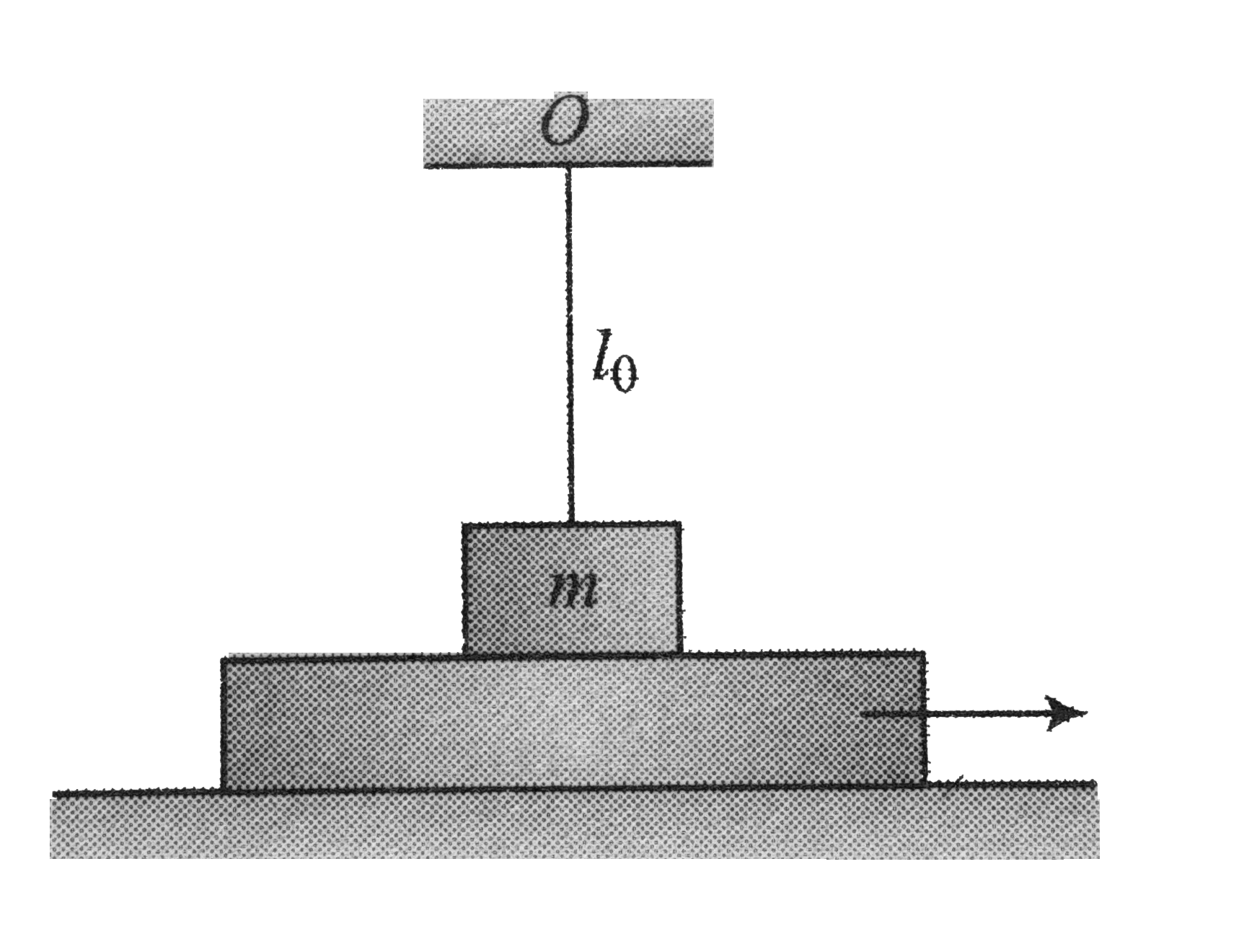
A horizontal plane supports a plank with a bar of mass `m` placed on it and attached by a light elastic non-deformed cord of length `l_0`, to a point O. The coefficient of friciton between the bar and the plank is equal to `mu`. The plank is slowly shifted to the right until the bar starts sliding over it. It occurs at the moment when the cord derivates from the vertical by an angle `theta`.

Find the work that has been performed by the moment by the frictional force acting on the bar in the reference frame fixed to the plane.

Text Solution

Verified by Experts
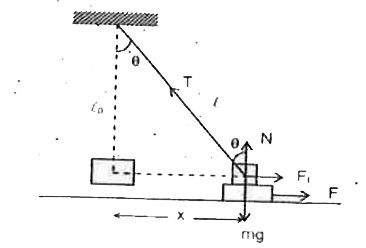
`N+T cos theta=mg` ...(i)
`F_(f)=T sin theta=0` ... (ii)
`:.F_(f)=T sin theta` ...(iii)
and `N=mg-T cos theta` ...(iv)
Further, `T=K(l-l_(0))=kl_(0)(sec theta -1)`
`x=l_(0)tan theta`
`dx=l_(0)sec^(2)theta d theta`
Work done, `dW=vec(F)_(f).dvec(s)=T sin theta (dx)`,
`W= int T sin theta(dx)`
`W=k l_(0)^(2)int_(theta=0)^(30^(@))(tan theta-sin theta)sec^(2)theta d theta= kl_(0)^(2)[((tan theta)^(2))/( 2)-(1)/(cos theta)]_(0)^(30^(@))=kl_(0)^(2)xx(0.012)`
when `theta=30^(@), kl_(0)(sec 30^(@)-1)=(0.2 mg)/(1/2+0.2xx(sqrt(3)/(2))`
`rArr kl_(0)=1.92mg`
`:.W=(0.023)mgl_(0)=0.092 J`.
Promotional Banner

Similar Questions

Explore conceptually related problems

A horizontal plane supports a plank with a block placed on it. A light elastic string is attached to the block, which is attached to a fixed point O. Initially, the cord is unstretched and vertical. The plank is slowly shifted to right until the block starts sliding over it. It occurs at the moment when the cord deviates from vertical by an angle theta=0^@ . Work done by the force F equals

A block of mass m is kept on a plank . The coefficient of friction between the plank and block is 1. The plank is slowly raised from one end so that it makes angle theta with horizontal . The forces of friction acting on the plank , when theta = 30 ^(@) and theta 60^(@) are respectively,

A plank with a bar placed on it performs horizontal harmonic oscillations with amplitude a=10cm . Find the coefficient of friction between the bar and the plank if the former starts sliding along the plank when the amplitude of oscillation of the plank becomes less than T=1.0 s .

A block is placed over a plank. The coefficient of friction between the block and the plank is mu= 0.2. Initially both are at rest, suddenly the plank starts moving with acceleration a_(0) = 4m//s^(2). The displacement of the block in 1 is (g=10m//s^(2))

A long plank of mass M is initially at rest on a frictionless surface. A small block with mass m and initial speed u_(0) slides on top of the larger plank. The coefficient of friction between the block and plank is mu Net work done by friction if the top block falls off the plank after sliding over its length L is

A block of mass m is gently placed over a massive plank moving horizontal over a smooth surface with velocity 10 ms^(-1) . The coefficient of friction between the block and the plank is 0.2. The distance travelled by the block till it slides on the plank is [g = 10 ms^(-2)]

A plank of mass M and length L is placed at rest on a smooth horizontal surface. A small block of mass m is projected with a velocity v_0 from the left end of it as shown in figure. The coefficient of friction between the block and the plank is m, and its value is such that the block becomes stationary with respect to the plank before it reaches the other end. a. Find the time and common velocity when relative sliding between the block and the plank stops. b. Find the work done by the friction force on the block during the period it slides on the plank. Is the work positive or negative? c. Calculate the work done on the plank during the same period. Is the work positive or negative? d. Also, determine the net work done by friction, Is it positive or negative?

A plank of mass 10 kg and a block of mass 2 kg are placed on a horizontal plane as shown in the figure. There is no friction between plane and plank. The coefficient of friction between block and plank is 0.5 .A force of 60 N is applied on plank horizontally. In first 2 s the work done by friction on the block is

Block A of mass m rests on the plank B of mass 3m which is free to slide on a frictionless horizo-ntal surface. The coefficient of friction between the block and plank is 0.2. If a horizontal force of magnitude 2 mg is applied to the plank B, the acceleration of A relative to the plank and relative to the ground respectively, are:

A block is kept on a rough horizontal plank. The coefficient of friction between the block and the plank is 1/2 . The plank is undergoing SHM of angular frequency 10 rad/s. The maximum amplitude of plank in which the block does not slip over the plank is (g= 10 m/ s^(2) )

