Home
Class 12
PHYSICS
Three particles each of mass m can slide...

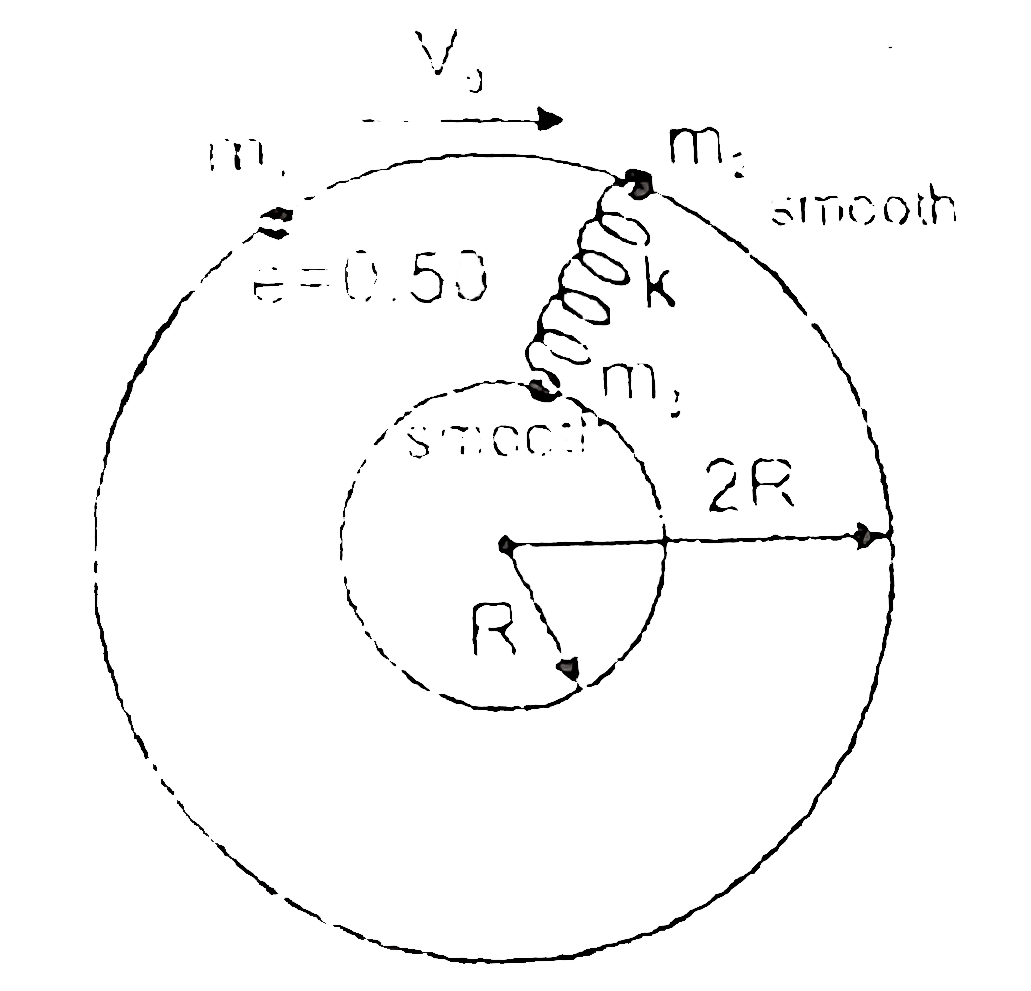
Three particles each of mass m can slide on fixed frictionless horizontal circular tracks in the same horizontal plane as shown in the figure. The coefficient of restitution being `e = 0.5`. Assuming that `m_(2)` and `m_(3)` are at rest initially and lie along a radial line before impact and the string is initially unstretched, then maximum extension in spring in subsequent motion

A

`1/4 v_( 0)sqrt((m)/(5K))`

B

`3/4 v_(0)sqrt((m)/(5K))`

C

`1/3 v_(0)sqrt((m)/(5K))`

D

`1/8 v_(0)sqrt((m)/(5K))`

Text Solution

Verified by Experts

The correct Answer is:

B

By the conservation of linear momentum between `m_(1)` and `m_(2)` and by using coefficient of restitution velocity `m_(2)` just after collision `(3v_(0))/(4)`.
After the collision, the maximum extension in the spring occurs when angular velocity of `m_(2)` and `m_(3)` about O become same. Now by conservation of angular momentum about .O. and energy conservation
Velocity of `m_(2)=2 R omega=3/5 v_(0)`
Velocity of `m_(3)=R omega = (3)/(10)v_(0)` and `Deltax` maximum `=3/4 v_(0) sqrt((m)/(5K))`
Promotional Banner

Similar Questions

Explore conceptually related problems

A block of mass m can slide along a frictionless inclined plane, is attached to a ideal spring of spring constant as shown in the figure. Find the period of its oscillation. (Frame of reference attached to the wedge is at rest)

A block of mass m is attached with a spring in vertical plane as shown in the figure. If initially spring is in its natural length and the block is released from rest, then maximum extension in the spring will be

A block of mass m attached with a an ideal spring of force constant k is placed on a rough inclined plane having inclination theta with the horizontal and coefficient of friction mu=1//2 tan theta , Initially the block is held stationary with the spring in its relaxed state, find the maximum extension in the spring if the block is released.

Two blocks A(3 kg) and B(2 kg) resting on a smooth horizontal surface is connected by a spring of stiffness 480N//m . Initially the spring is underformed and a velocity of 2 m//s is imparted to A along the line of the spring away from B. The maximum extension in meters of the spring during subsequent motion is :-

A body of mass m is attached by an inelastic string to a suspended spring of spring constant k . Both the string and the spring have negligible mass and the string is inextensible and of length L . Initially, the mass m is at rest. Q. If the mass m is now raised up to point A (the top end of the string see fig. and allowed to fall from rest, the maximum extension of the spring in the subsequent motion will be

A small ring of mass m is constrained to slide along a horizontal wire fixed between two rigid supports. The ring is connected to a particle of same mass by an ideal string & the whole system is released from rest as shown in the figure. If the coefficient of friction between ring A and wire is (3)/(5) , the ring will start sliding when the connecting string will make an angle theta with the vertical, then theta will be (particle is free to move and ring can slide only)

Two moasses m_(1)=5kg and m_(2)=10kg, connected by an inextensible string over a frictionless pulley, are moving as shown in the figure. The coefficient of friction of horizontal surface is 0.15. The minimum weitght m that should be put on top of m_(2) to stop the motion is :-

Three particles A, B and C of respective masses m_(1), m_(2) and m_(3) lie on a smooth horizontal surface, and an fastened to two light inextensible strings as shown in Fig. The particle A is imparted an impulse J along vec(BA) . Find the initial speed of each particle.

The figure shows two blocks of mass m each, connected by an ideal unstretched spring and then placed on a frictionless floor. If the blocks are given velocities v_(0) and 2v_(0) as shown, then the maximum extension in the spring is

A particle of mass 'm' is projected with velocity v_(0) at an angle 'alpha' with the horizontal. The coefficient of restitution for any of its impact with the smooth ground is e . Find total time taken by the particle before it stops moving vertically?
