Home
Class 12
PHYSICS
A spring of mass m lies on a smooth tabl...

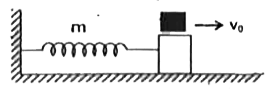
A spring of mass m lies on a smooth table. One, end of it is clamped to the vertical wall and other end is attached to a mass m ( as shown in fig) and is placed on a horizontal frictionless surface. If the block of mass M is given a velocity `v_(0)` towards right find the K.E. of the system . ( AsSigmae velocity in spring is varying linearly).

Text Solution

Verified by Experts

The correct Answer is:

`((3M+m)/(6))(v_(0))^(2)`
Promotional Banner

Similar Questions

Explore conceptually related problems

The figure shows two blocks of mass m each, connected by an ideal unstretched spring and then placed on a frictionless floor. If the blocks are given velocities v_(0) and 2v_(0) as shown, then the maximum extension in the spring is

A block A of mass m is placed over a plank B of mass 2m plank B is placed over a smooth horizontal surface .The coefficient of friction between A and B is 0.4 Block A is given a velocity v_(0) toward right Find acceleration (in ms^(-2) of B relative to A

AB is a long frictionless horizontal surface. One end of an ideal spring of spring constant K is attached to a block of mass m, which is being moved left with constant velocity v, and the another end is free. Another block of mass 2m is given a velocity 3v towards the spring. Magnitude of work done by external agent in moving m with constant velocity v in long time is beta times mv^(2) . Find the value of beta

Two blocks of masses m_1 and m_2 are connected by a spring of spring constant k figure. The block of mass m_2 is given a shape impulse so that it acquires a velocity v_0 towards right. Find a. the velocity of the centre of mass b. the maximum elongation that the spring will suffer.

A spring with one end attached to a mass and the other to a right support is stretched and released

A block of mass m moving with velocity v_(0) on a smooth horizontal surface hits the spring of constant k as shown. The maximum compression in spring is

A block of mass m is moving with an initial velocity v_0 towards a stationary spring of stiffness k attached to the wall as shown in figure a. Find the maximum compression in the spring. b. Is the work done by the spring negative or positive?

A block of mass m is dropped onto a spring of constant k from a height h . The second end of the spring is attached to a second block of mass M as shown in figure. Find the minimum value of h so that the block M bounces off the ground. If the block of mass m sticks to the spring immediately after it comes into contact with it.

One end of a spring of force constant k is fixed to a vertical wall and the other to a blcok of mass m resting on a smooth horizontal surface. There is another wall at distance x_(0) from the block. The spring is then compressed by 2x_(0) and released. The time taken to strike the wall is

One end of a spring of force constant k is fixed to a vertical wall and the other to a blcok of mass m resting on a smooth horizontal surface. There is another wall at distance x_(0) from the block. The spring is then compressed by 2x_(0) and released. The time taken to strike the wall is
