Home
Class 12
PHYSICS
A conservative force acts on a particle...

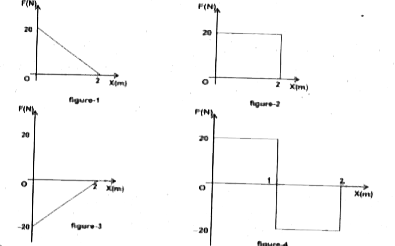
A conservative force acts on a particle as the particle moves along the positive x-axis from origin origin to `x=2m`. The force is parallel to x-axis. Now, consider four different cases, as shown in the figures, 1, 2, 3, and 4, where the forces is shown as a function of x. Rank the situations according to the change in potential energy associated with the force, least ( or most negative) to greatest ( or most positive).

A

2, 1, 4, 3

B

3, 4, 1, 2

C

1, 2, 3, 4

D

4, 2, 3, 1

Text Solution

Verified by Experts

The correct Answer is:

A
Promotional Banner

Similar Questions

Explore conceptually related problems

A single force acts on a particle situated on the negative x-axis. The torque about the origin is in the positive z-direction. The force is

A particle is to move along the x- axis from x=0 to x=x_(1) while a conservative force, directed along the x- axis, acts on the particle. For each force defination presented in the figures the maximum magnitude of the force (F_(1)) is the same for all cases. Rank the forces according to the change in potential energy associated with the motion shown. from most positive to most negative :

A particle mass parallel to x-axis with constant velocity v as shown in the figure. The angular velocity of the particle about the origin O

A force F acting on a particle varies with the position x as shown in figure. Find the work done by this force in displacing the particle from

A particle moves along the X-axis from x=0 to x=5 m under the influence of a force given by F=7-2x+3x^(2). Find the work done in the process.

Figure shows the displacement of a particle going along the X-axis as a function of time. The force acting on the particle is zero in the region

Force acting on a particle varies with displacement as shown is Fig. Find the work done by this force on the particle from x=-4 m to x = + 4m. .

As a particle moves along the x- axis, it is acted upon by a conservative force. The potential energy is shown below as a function of the coordinate x of the particle. Rank the labelled regions accoeording to the magnitude of force, least to greatest.

A force vecF=(4hati+5hatj)N acts on a particle moving in XY plane. Starting from origin, the particle first goes along x-axis to the point (5.0) m and then parallel to the Y-axis to the point (5,4 m. The total work done by the force on the particle is

A position dependent force F acting on a particle and its force-position curve is shown in the figure. The work done by force from x = 1 m to x = 4 m is
