Home
Class 12
PHYSICS
A syringe of diameter D = 8 mm and havin...

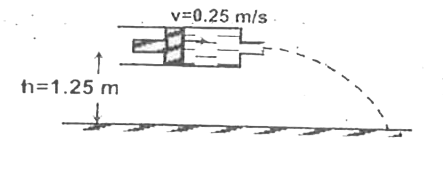
A syringe of diameter D = 8 mm and having a nozzie of diameter d = 2 mm is placed horizontally at a height of `1.25` m as shown in the figure . An incompressible and non - viscous liquid is filled in syringe and the piston is moved at speed of `0.25` m/s .Find the range of liquid jet on the ground.

Text Solution

Verified by Experts

AV = Constant
`D^(2)V = d^(2)v`
` v = (D^(2))/(d^(2)) V = (8/2)^(2) xx0.25 = 16 xx 0.25 = 4 ` m/s
` x = v sqrt((2h)/g) = 4 sqrt((2xx1.25)/10 ) = 4 xx 1/2 = 2m `
Promotional Banner

Similar Questions

Explore conceptually related problems

Liquid is filled in a vessel of square base (2mxx2m) upto a height of 2m as shown in figure (i). In figure (ii) the vessel is tilted from horizontal at 30^(@) . At what distance from point O, will the liquid strike on the ground?

Consider a horizontally oriented syringe containing water locate at a height of 1.25 m above the ground. Thediameter of the plunger is 8 mm and the diameter of the nozzle is 2 mm . The plunger is pushed with a constant speed of 0.25m//s. Find the horizontal range of water stream on the grond. Take g=10 m//s^(2)

Liquid is filled in a vessel of square base (2mxx2m) upto a height of 2m as shown in figure (i). In figure (ii) the vessel is tilted from horizontal at 30^(@) . What is time of fall of liquid on the ground?

A container of large uniform cross sectonal area A , resting on horizontal surface, holds two immiscible non viscous and incompresible liquids of density d and 2d , each of height H/2 as shown in the figure. The lower density liquid is open to the atmosphere having pressure P_(0) . A tiny hole of area s(s a.the initial speed of efflux of the liquid at the hole b. the horizontal disance x travelled by the liquid initially c. the height h_m at which at the hole should be punched so that the liquid travels the maximum distance x_(m) initially. also calculate x_(m) (neglect air resistance inte calculations).

A container of large uniform cross sectional area A , resting on horizontal surface, holds two immiscible non viscous and incompressible liquids of density d and 2d , each of height H/2 as shown in the figure. The lower density liquid is open to the atmosphere having pressure P_(0) . A tiny hole of area (s(sltltA) is punched on the vertical side of the container at a height h(hltH/2) . Determine the initial speed of efflux of the liquid at the hole

A container of large uniform cross sectional area A , resting on horizontal surface, holds two immiscible non viscous and incompressible liquids of density d and 2d , each of height H/2 as shown in the figure. The lower density liquid is open to the atmosphere having pressure P_(0) . A tiny hole of area (s(sltltA) is punched on the vertical side of the container at a height h(hltH/2) . Determine The horizontal distance traveled by the liquid, initially, is :

In the determination if Young's modulus ((Y = (4MLg)/(pild^(2)) by using searle's method, a wire of length L=2m and diameter d=0.5mm is used. For a load M=2.5kg , an extension l=0.25mm in the length of the wire is observed. Quantites D and l are measured using a screw gauge and a micrometer, respectively. they have the same pitch of 0.5mm . the number of divisions on their circular scale is 100 . the contrubution to the maximum probable error of the Y measurement

A long cylindrical tank of cross-sectional area 0.5m^(2) is filled with water. It has a small hole at a height 50cm from the bottom. A movable piston of cross-sectional area almost equal to 0.5m^(2) is fitted on the top of the tank such that it can slide in the tank freely. A load of 20 kg is applied on the top of the water by piston, as shown in the figure. Calculate the speed of the water jet with which it hits the surface when piston is 1m above the bottom. (Ignore the mass of the piston)

A metal plate of area 0.10m^(2) is connected to a 0.01 kg mass via a string that passes over an ideal pulley (considered to be friction-less), as shown in the figure. A liquid with a film thickness of 3.0 mm is placed between the plate and the table. When released the plate moves to the right with a constant speed of 0.085ms^(-1) . Find the coefficient of viscosity of the liquid.

Fluids at rest exert a normal force to the walls of the container or to the sruface of the body immersed in the fluid. The pressure exerted by this force at a point inside the liqid is the sum of atmospheric pressure and a factor which depends on the density of the liquid, the acceleration due to gravity and the height of the liquid, above that point. The upthrust acting on a body immersed in a stationary liquid is the net force acting on the body in the upward direction. A number of phenomenon of liquids in motion can be explain by Bernoulli's theorem which relates the pressure, flow speed and height for flow of an ideal incompressible fluid. A container of large uniform corss sectional area. A resting on a horizontal surface holds two immiscible, non viscous and incompressile liquids of densities d and 2d , each of height H//2 as shown in the figure. The lower density liquid is open to the atmosphere having pressure P_(0) . Situation II: A cyliner is removed and the original arrangement is restoreed.A tiny hole of area s(slt ltA) is punched on the veritical side of the containier at a height h(hltH//2) The height h_(m) at which the hole should be punched so that the liquid travels the maximum distance is
