Home
Class 12
PHYSICS
A cube of mass m and density D is suspen...

A cube of mass `m` and density `D` is suspended from a point `P` by a spring of stiffness `k`. The system is kept inside a beaker filled with a liquid of density `d`. The elongation in the spring, assuming `D gt d`, is :

A

`(mg)/k (1-d/D)`

B

`(mg)/1 (1-D/d)`

C

`(mg)/k (1+d/D)`

D

None of these

Text Solution

Verified by Experts

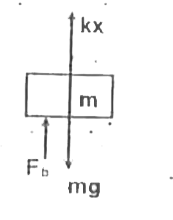
The cube is in equilibrium under the following three forces ,
spring force kx , where x = elongation of the spring ,
gravitional force w , weight of the cube = mg
buoyant force `F_(b)` ( or upward thrust ) imparted by the liquid on the cube given as `F_(b) = Vdg` where V = volume of the immersed portion of the cube equilibrium of the cube , ` kx + F_(b) = mg`
`rArr x = (mg -F_(b))/(k) = (mg- Vdg)/k ` where V = volume he immersed portion of the cube , For complete immersion , V = volume of the cube
For equilibrium of the cube , ` kx + F_(b) = mg`
` rArr = (mg-F_(b))/k = (mg-Vdg)/k ` Where V = (m/D)
` rArr x = (mg)/k (1- d/D)`
Hence (A) is correct
Promotional Banner

Similar Questions

Explore conceptually related problems

A block of mass m suspended from a spring of spring constant k . Find the amplitude of S.H.M.

A vessel filled with water is kept on a weighing pan and the scale adjusted of zero. A block of mass M and density rho is suspended by a masselss spring of spring constant k. This block is submerged inside into the water in the vessel. What is the reading of the scale /

A rod mass (M) hinged at (O) is kept in equilibrium with a spring of stiffness (k) as shown in figure. The potential energy stored in the spring is .

A mass M is suspended as shown in fig. The system is in equilibrium. Assume pulleys to be massless. K is the force constant of the spring. The extension produced in the spring is given by

A block of mass m is suddenly released from the top of a spring of stiffness constant k. a. Find the acceleration of block just after release. b. What is the compression in the spring at equilibrium. c. What is the maximum compression in the spring. d. Find the acceleration of block at maximum compression in the spring.

A uniform cylinder of length L and mass M having cross-sectional area A is suspended, with its length vertical, from a fixed point by a massless spring such that it is half submerged in a liquid of density sigma at equilibrium position. The extension x_0 of the spring when it is in equlibrium is:

A uniform cylinder of length L and mass M having cross-sectional area A is suspended, with its length vertical, from a fixed point by a massless spring such that it is half submerged in a liquid of density sigma at equilibrium position. The extension x_0 of the spring when it is in equlibrium is:

A mass m is vertically suspended from a spring of negligible mass, the system oscillates with a frequency n. what will be the frequency of the system, if a mass 4m is suspended from the same spring?

Two identicle particles A and B, each of mass m, are interconnected by a spring of stiffness k. If particle B experiences a forec F and the elongation of the spring is x, the acceleration of particle B relative to particle A is equal to

A block of density 2000kg//m^3 and mass 10kg is suspended by a spring stiffness 100N//m . The other end of the spring is attached to a fixed support. The block is completely submerged in a liquid of density 1000kg//m^3 . If the block is in equilibrium position.