Home
Class 12
PHYSICS
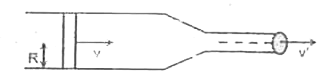
A piston of a syringe pushes a liquid ...

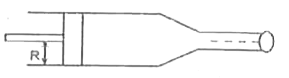
A piston of a syringe pushes a liquid with a speed of 1 cm, / sec . The radii of the syring tube and the needle are R = 1 cm and r = `0.5` mm respectively . The velocity of the liquid coming out of the needle is

A

2 cm/sec

B

400 cm,/sec

C

10 cm/sec

D

None of these

Text Solution

Verified by Experts

According to the equation of continuity ,
Av = av.
`rArr v. = (A//a)v`
where ` A = pi R^(2) and a = pir^(2)`
` rArr v . (R/r)^(2) v = ((1 cm )/(0.05 cm))^(2) (1 cm//sec ) = 400 ` cm/sec
Promotional Banner

Similar Questions

Explore conceptually related problems

A spray gun is shown in the figure where a piston pushes air out of a nozzle. A thin tube of uniform cross section is connected to the nozzle. The other end of the tube is connected with a small liquid container. As the piston pushes air through the nozzle, the liquid from the container rises into the nozzle and is sprayed out. For the spray gun shown, the radii of the piston and the nozzle are 20 mm and 1 mm respectively. The upper end of the container is open to the atmosphere. If the piston is pushed at a speed of 5 mm s ^(-1) the air comes out of the nozzle with a speed of :

A spray gun is shown in the figure where a piston pushes air out of a nozzle. A thin tube of uniform cross section is connected to the nozzle. The other end of the tube is in a small liquid container. As the piston pushes air through the nozzle, the liquid from the container rises into the nozzle and is sprayed out. For the spray gun shown, the radii of the piston and the nozzle are 20mm and 1mm respectively. The upper end of the container is open to the atmosphere. If the density of air is rho_a , and that of the liquid rho_l , then for a given piston speed the rate (volume per unit time) at which the liquid is sprayed will be proportional to

A uniform solid cylinder of density 0.8g//cm^3 floats in equilibrium in a combination of two non-mixing liquids A and B with its axis vertical. The densities of the liquids A and B are 0.7g//cm^3 and 1.2g//cm^3 , respectively. The height of liquid A is h_A=1.2cm. The length of the part of the cylinder immersed in liquid B is h_B=0.8cm . (a) Find the total force exerted by liquid A on the cylinder. (b) Find h, the length of the part of the cylinder in air. (c) The cylinder is depressed in such a way that its top surface is just below the upper surface of liquid A and is then released. Find the acceleration of the cylinder immediately after it is released.

A uniform solid cylinder of density 0.8g//cm^3 floats in equilibrium in a combination of two non-mixing liquids A and B with its axis vertical. The densities of the liquids A and B are 0.7g//cm^3 and 1.2g//cm^3 , respectively. The height of liquid A is h_A=1.2cm. The length of the part of the cylinder immersed in liquid B is h_B=0.8cm . (a) Find the total force exerted by liquid A on the cylinder. (b) Find h, the length of the part of the cylinder in air. (c) The cylinder is depressed in such a way that its top surface is just below the upper surface of liquid A and is then released. Find the acceleration of the cylinder immediately after it is released.

A uniform solid cylinder of density 0.8g//cm^3 floats in equilibrium in a combination of two non-mixing liquids A and B with its axis vertical. The densities of the liquids A and B are 0.7g//cm^3 and 1.2g//cm^3 , respectively. The height of liquid A is h_A=1.2cm. The length of the part of the cylinder immersed in liquid B is h_B=0.8cm . (a) Find the total force exerted by liquid A on the cylinder. (b) Find h, the length of the part of the cylinder in air. (c) The cylinder is depressed in such a way that its top surface is just below the upper surface of liquid A and is then released. Find the acceleration of the cylinder immediately after it is released.

Two liquid drop have diameters of 1 cm and 1.5 cm. The ratio of excess pressures inside them is

A coaxial cylinder made of glass is immersed in a-liquid of surface tension S. The radius of the inner and outer surface of the cylinder are R_1 and R_2 respectively . Height till which liquid will rise is (Density of liquid is rho )

A pipe of non uniform cross section has two distinct section 1 and 2 with areas 2cm^(2) and 4cm^(2) respectively. If the velocity of flowing liquid at section 1 is 5cm//s , determine the velocity at section 2 .

A liquid flows through a horizontal tube as shown in figure. The velocities of the liquid in the two sections, which have areas of cross-section A_(1) and A_(2) and v_(1) and v_(2) respectively. The differnece in the levels of the liquid in the two vertical tubes is h . then

A liquid flows through a horizontal tube. The velocities of the liquid in the two sections, which have areas of cross section A_(1) and A_(2) are v_(1) and v_(2) respectively. The difference in the levels of the liquid in the two vertical tubes is h . Then