Home
Class 12
PHYSICS
A cylindrical tank having cross - secti...

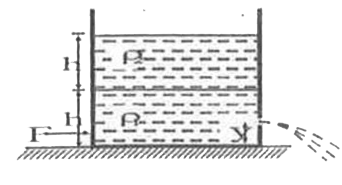
A cylindrical tank having cross - sectional area `A = 0.5 m^(2)` is filled with two liquids of density `rho_(1)= 900 " kg "m^(-3) and rho_(2) = 600 " kg "m^(-3)` , to a height h ` = 60 cm^(2)`each.A small hole having area a=5 cm^2 is made in right vertical wall at a height y = 20 cm from the bottom . A horizontal force F is applied on the tank to keep it in static equilibrium . The tank is lying on a horizontal surfaces . Neglect mass of cylindrical tank camparison to mass of liquids ( take ` g = 10 ms^(-2)`)

Horizontal force F to keep the cylinder in static equilibrium , if it is placed on a smooth horizontal thrust exerted by fluid jet . But that is equal to mass flowing per second `xx` change in velocity of this mass
` :. " " F = (avrho) (v-0) = a rho v^(2)`
or `F = 7.2 N `

A

`7.2` N

B

`10 N`

C

`15.5 N`

D

`20 . 4 ` N

Text Solution

Verified by Experts

When cylinder is on smooth horizontal plane force F required to keep cylinder stationary equals horizontal thrust exerted by fluid jet . But that is equal to mass flowing per second ` xx` change in velocity of this mass
Promotional Banner

Similar Questions

Explore conceptually related problems

A cylindrical tank having cross-sectional area A = 0.5 m^(2) is filled with two liquids of density rho_(1)=900 kg m^(-3) and rho_(2)=600 kgm^(-3) , to a height h=60cm each as shown in the figure. A small hole having area a=5cm^(2) is made in right vertical wall at a height y = 20 cm from the bottom. A horizontal force F is applied on the tank to keep it in static equilibrium. The tank is lying on a horizontal surface. Neglect mass of the cylindrical tank in comparison to mass of the liquids ( ake g = 10 ms^(-2) ). The horizontal force required to keep the cylinder in static equilibrium, on a smooth horizontal plane is

A cylindrical tank having cross-sectional area A = 0.5 m^(2) is filled with two liquids of density rho_(1)=900 kg m^(-3) and rho_(2)=600 kgm^(-3) , to a height h=60cm each as shown in the figure. A small hole having area a=5cm^(2) is made in right vertical wall at a height y = 20 cm from the bottom. A horizontal force F is applied on the tank to keep it in static equilibrium. The tank is lying on a horizontal surface. Neglect mass of the cylindrical tank in comparison to mass of the liquids (Take g = 10 ms^(-2) ). The velocity of efflux is

A cylindrical tank having cross - sectional area A = 0.5 m^(2) is filled with two liquids of density rho_(1)= 900 " kg "m^(-3) and rho_(2) = 600 " kg "m^(-3) , to a height a = 6 cm^(2) is made in right vertical wall at a height y = 20 cm from the bottom . A horizontal force F is applied on the tank to keep it in static equilibrium . The tank is lying on a horizontal surfaces . Neglect mass of cylindrical tank camparison to mass of liquids ( take g = 10 ms^(-2) ) Minimum and maximum values of F to keep the cylinder in static just after the water starts to spill through the hole . If the co - efficient of static friction between contact surfaces is 0.01

A cylindrical tank having cross-sectional area A = 0.5 m^(2) is filled with two liquids of density rho_(1)=900 kg m^(-3) and rho_(2)=600 kgm^(-3) , to a height h=60cm each as shown in the figure. A small hole having area a=5cm^(2) is made in right vertical wall at a height y = 20 cm from the bottom. A horizontal force F is applied on the tank to keep it in static equilibrium. The tank is lying on a horizontal surface. Neglect mass of the cylindrical tank in comparison to mass of the liquids ( ake g = 10 ms^(-2) ). (i) horizontal force F to keep the cylinder in static equilibrium, if it is placed on a smooth horizontal plane and (ii) minimum and maximum values of F to keep the cylinder in static equilibrium, if coefficient of friction between the cylinder and the plane is µ = 0.01. (g = 10 ms –2 )

A cylinderical tank having cross sectional area ^^=0.5m^(2) is filled liquids of densities rho_(1)=900kgm^(3)&rho_(2)=600kgm^(3) to a height h=60cm as shown in the figure a small hole having area a=5cm^(2) is made in right vertical wall at a height y=20cm from the bottom calculate. (i). velocity of efflux (ii). horizontal force F to keep the cylinder in static equilibrium if it is placed on a smooth horizontal plane (iii). minimum and maximum value of F to keep the cylinder at rest. The coefficient of friction between cylinder and the plane is mu=0.1 (iv). velocity of the top most layer of the liquid column and also the velocity of the boundary separating the two liquids.

A cubical tank of side 1 m is filled with 800 kg of a liquid. Find the density of liquid in kg m^(-3)

A cylindrical vessel of a very large cross sectional area is containing two immiscible liquids of density rho_(1)=600kg//m^(3) and rho_(2)=1200kg//m^(3) as shown in the figure. A small hole having cross sectional area 5cm^(2) is made in right side vertical wall as shown. Take atmospheric pressure as p_(0)=10^(5)N//m^(2), g=10m//s^(2) . For this situation mark out the correct statement (s). Take cross sectional area of the cylindrical vessel as 1000cm^(2) . Neglect the mass of the vessel.

Water is filled in a container upto height 3m. A small hole of area 'a' is punched in the wall of the container at a height 52.5 cm from the bottom. The cross sectional area of the container is A. If a//A=0.1 then v^2 is (where v is the velocity of water coming out of the hole)

The level of water in a tank is 5 m high . A hole of the area 10 cm^2 is made in the bottom of the tank . The rate of leakage of water from the hole is

A cube of 1 kg is floating at the interface of two liquids of density rho_(1) = 3//4 gm//cm^(3) and rho_(2) = 2.5 gm//cm^(3) The cube has (3//5)^(th) part in rho_(2) and (2//5)^(th) part in rho_(1) .Find the density of the cube .

