Home
Class 12
PHYSICS
When a viscous liquid flows , adjacent...

When a viscous liquid flows , adjacent layers oppose their relative motion by applying a viscous force given by
` F = - eta A (dv)/(dz)`
where , eta = coefficient of viscosity ,
A = surface area of adjacent layers in contact ,
` (dv)/(dz)` = velocity gradient
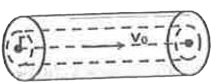
Now , a viscous liquid having coefficient of viscosity `eta ` is flowing through a fixed tube of length l and radius R under a pressure difference P between the two ends of the tube . Now consider a cylindrical vloume of liquid of radius r . Due to steady flow , net force on the liquid in cylindrical volume should be zero .
` - eta 2pirl (dv)/(dr) = Ppir^(2)`
` - int _(v)^(0),dv = P/(2 eta l) int_(tau)^(R) rdr ( :' ` layer in contact with the tube is stationary )
` v = v_(0) (1- (r^(2))/(R^(2)))` , where `v_(0) = (PR^(2))/(4nl)`
` :. " " Q = (piPR^(4))/(8sta l)`
This is called Poisecuille's equation .

The velocity of flow of liquid at r = R/2 is

A

`(3PR^(2))/(16etal)`

B

`(PR^(2))/(8eta l)`

C

`(PR^(2))/(4 eta l)`

D

` (PR^(2))/(2etal)`

Text Solution

Verified by Experts

The correct Answer is:

A
Promotional Banner

Similar Questions

Explore conceptually related problems

When a viscous liquid flows , adjacent layers oppose their relative motion by applying a viscous force given by F = - eta A (dv)/(dz) where , ete = coefficient of viscosity , A = surface area of adjacent layers in contact , (dv)/(dz) = velocity gradient Now , a viscous liquid having coefficient of viscosity eta is flowing through a fixed tube of length l and radius R under a pressure difference P between the two ends of the tube . Now consider a cylindrical vloume of liquid of radius r . Due to steady flow , net force on the liquid in cylindrical volume should be zero . - eta 2pirl (dv)/(dr) = Ppir^(2) - int _(v)^(0),dv = P/(2 eta l) int_(tau)^(R) rdr ( :' layer in contact with the tube is stationary ) v = v_(0) (1- (r^(2))/(R^(2))) , where v_(0) = (PR^(2))/(4nl) :. " " Q = (piPR^(4))/(8etaL) This is called Poisecuille's equation . The viscous force on the cylindrical volume of the liquid varies as

When a viscous liquid flows , adjacent layers oppose their relative motion by applying a viscous force given by F = - eta A (dv)/(dz) where , ete = coefficient of viscosity , A = surface area of adjacent layers in contact , (dv)/(dz) = velocity gradient Now , a viscous liquid having coefficient of viscosity eta is flowing through a fixed tube of length l and radius R under a pressure difference P between the two ends of the tube . Now consider a cylindrical vloume of liquid of radius r . Due to steady flow , net force on the liquid in cylindrical vloume should be zero . - eta 2pirl (dv)/(dr) = Ppir^(2) - int _(v)^(0),dv = P/(2 eta l) int_(tau)^(R) rdr ( :' layer in contact with the tube is stationary ) v = v_(0) (1- (r^(2))/(R^(2))) , where v_(0) = (PR^(2))/(4nl) :. " " Q = (piPR^(4))/(8sta l) This is called Poisecuille's equation . The volume of the liquid flowing per sec across the cross - section of the tube is .

Viscous drag force depends on

Viscous drag force depends on

Reynolds number for a liquid of density rho , viscosity eta and flowing through a pipe of diameter D, is given by

Volume rate flow of a liquid of density rho and coefficient of viscosity eta through a cylindrical tube of diameter D is Q. Reynold's number of the flow is

A liquid having coefficient of viscosity 0.02 decapoise is filled in a container of cross-sectional area 20 m^2 viscous drag between two adjacent layers in flowing is 1 N, then velocity gradient is

The rate of flow of liquid in a tube of radius r, length l, whose ends are maintained at a pressure difference P is V = (piQPr^(4))/(etal) where eta is coefficient of the viscosity and Q is

Which one of the following represents the correct dimensions of the quantity : x=(eta)/(rho) , where eta =coefficient of visocosity and rho =the density of a liquid?

The critical velocity v for a liquid depends upon (a) coefficient of viscosity eta (b) density of the liquid rho and © radius of the pipe r. Using dimensions derive an expression for the critical velocity.
