Home
Class 12
PHYSICS
In the figure shown a planet moves in an...

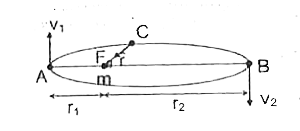
In the figure shown a planet moves in an elliptical orbit around the sun. Compare the speeds, linear and angular momenta at the points `A` and `B`.

Text Solution

Verified by Experts
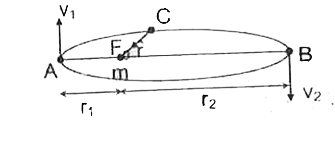
Kepler.s Law of Areas is a consequence of the conservation of angular momentum of the planet about the sun . Since the central force `vecF_(g)=(GMm)/(r^(2)).hatr` passes through the sun, the torque of this force the sun is zero. Therefore its angular momenta about the sun at `A` and `B` remain constant
`impliesL_(A)=L_(B)`
`impliesmv_(1)r_(1)=mv_(2)r_(2)`
`implies(v_(1))/(v_(2))=(r_(2))/(r_(1))`
Ratio of angular momenta
`(L_(1))/(L_(2))=(mv_(1)r_(1))/(mv_(2)r_(2))=1`
`(P_(1))/(P_(2))=(mv_(1))/(mv_(2))=(r_(2))/(r_(1))`
Promotional Banner

Similar Questions

Explore conceptually related problems

Figure shows a planet in an elliptical orbit around the Sun S . Where is the kinetic energy of the planet maximum?

When a planet moves around the sun

Consider a planet moving in an elliptical orbit round the sun. The work done on the planet by the gravitational force of the sun

A planet revolves in elliptical orbit around the sun. (see figure). The linear speed of the planet will be maximum at

A planet revolves in elliptical orbit around the sun. (see figure). The linear speed of the planet will be maximum at

Consider a planet moving in an elliptical orbit around the Sun. The work done on the planet by the gravitational force of the Sun

A planet is moving round the sun in an elliptical orbit as shows. As the planet moves from A to B

A planet travels in an elliptical orbit about a star as shown. At what pair of points is the speed of the planet the same?

The earth revolves round the sun in an elliptical orbit. Its speed

A satellite S is moving in an elliptical orbit around the earth. The mass of the satellite is very small compared to the mass of the earth.

