Home
Class 12
PHYSICS
A planet of mass m revolves in elliptica...

A planet of mass `m` revolves in elliptical orbit around the sun of mass `M` so that its maximum and minimum distance from the sun equal to `r_(a)` and `r_(p)` respectively. Find the angular momentum of this planet relative to the sun.

Text Solution

Verified by Experts
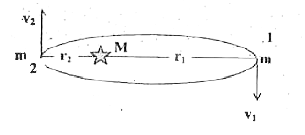
The angular momentum
`L=mvr`………`(1)`
Conservation of angular momenta at point `1` and `2` ,
`mv_(1)r_(1)=mv_(2)r_(2)`
`impliesv_(1)r_(1)=v_(2)r_(2)`………..`(2)`
Conservation of energy at `1` and `2`
`(1)/(2)mv_(1)^(2)-(GMm)/(r_(1))=(1)/(2)mv_(2)^(2)-(GMm)/(r_(2))`..........`(3)`
Using equation `(2)` and `(3)` we obtain
`v_(1)=sqrt(2GM((1)/(r_(1))-(1)/(r_(2)))+v_(2)^(2))`
`impliesv_(1)=sqrt(2GM((1)/(r_(1))-(1)/(r_(2)))+((v_(1)r_(1))/(r_(2)))^(2))`
`impliesv_(1)^(2)[1-((r_(1))/(r_(2)))^(2)]=2GM((r_(2)-r_(1))/(r_(1)r_(2)))`
`impliesv_(1)=sqrt((2GMr_(2))/(r_(1)(r_(1)+r_(2))))`
`:.L=mv_(1)r_(1)=msqrt((2GMr_(1)r_(2))/(r_(1)+r_(2)))`
Promotional Banner

Similar Questions

Explore conceptually related problems

A planet of mass m moves along an ellipse around the Sun so that its maximum and minimum distances from the Sun are equal to r_1 and r_2 respectively. Find the angular momentum M of this planet relative to the centre of the Sun.

A planet of mass m moves along an ellipse around the sum of mass M so that its maximum and minimum distances from sum are a and b respectively. Prove that the angular momentum L of this planet relative to the centre of the sun is L=msqrt((2GMab)/((a+b)))

A planet of mass m is moving in an elliptical orbit about the sun (mass of sun = M). The maximum and minimum distances of the planet from the sun are r_(1) and r_(2) respectively. The period of revolution of the planet wil be proportional to :

A planet of mass m moves around the Sun of mass Min an elliptical orbit. The maximum and minimum distance of the planet from the Sun are r_(1) and r_(2) , respectively. Find the relation between the time period of the planet in terms of r_(1) and r_(2) .

A planet revolves in elliptical orbit around the sun. (see figure). The linear speed of the planet will be maximum at

A planet revolves in elliptical orbit around the sun. (see figure). The linear speed of the planet will be maximum at

A planet of small mass m moves around the sun of mass M along an elliptrical orbit such that its minimum and maximum distance from sun are r and R respectively. Its period of revolution will be:

Speed of a planet in an ellioptical orbit with semimajor axis a about sun of mass M at a distance r from sun is

A sayellite of mass m revolves in a circular orbit of radius R a round a planet of mass M. Its total energy E is :-

The distance of two planets from the sun are 10^(13) and 10^(12) m respectively. The ratio of the periods of the planet is

