Home
Class 12
PHYSICS
Four particles of equal masses M move al...

Four particles of equal masses M move along a circle of radius R under the action of their mutual gravitational attraction. Find the speed of each particle.

Text Solution

Verified by Experts
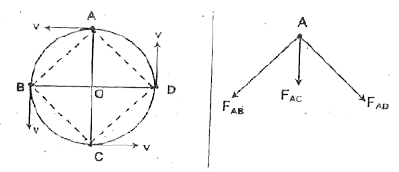
The gravitational force on each mass due to other `3` masses provides the necessary centripetal force . Consider the particle `A`, Net force on particle `A` is given by
`vecF_(A)=vecF_(AB)+vecF_(AD)+vecF_(AC)`
`impliesF_(AY)=(GM^(2))/((AB)^(2))cos45^(@)+(GM^(2))/((AD)^(2))cos45^(@)+(GM^(2))/((AC)^(2))`
`=(GM^(2))/((sqrt(2)R)^(2))(1)/(sqrt(2))+(GM^(2))/((sqrt(2)R)^(2))(1)/(sqrt(2))+(GM^(2))/((2R)^(2))=(2GM^(2))/(2sqrt(2)R^(2))+(GM^(2))/(4R^(2))=(GM^(2))/(R^(2))[(1)/(sqrt(2))+(1)/(4)]` along `AO`
This must provide the necessary centripetal force
Hence, `(GM^(2))/(R^(2))[(1)/(sqrt(2))+(1)/(4)]=(Mv^(2))/(R )`
`impliesv=sqrt((GM)/(R )[(2sqrt(2)+1)/(4)])`
Promotional Banner

Similar Questions

Explore conceptually related problems

Two particles of equal mass go round a circle of radius R under the action of their mutual gravitational attraction. Find the speed of each particle.

Two particles of equal mass (m) each move in a circle of radius (r) under the action of their mutual gravitational attraction find the speed of each particle.

Two particles of equal mass go around a circle of radius R under the action of their mutual gravitational attraction. The speed v of each particle is

Two particles of equal masses m go round a circle of radius R under the action of their mutual gravitational attraction. The speed of each particle is v=sqrt((Gm)/(nR)) . Find the value of n.

Four particles of equal mass are moving round a circle of radius r due to their mutual gravitational attraction . Find the angular velocity of each particle .

Four particles, each of mass M and equidistant from each other, move along a circle of radius R under the action of their mutual gravitational attraction. The speed of each particle is:

Four particles, each of mass M and equidistant from each other, move along a circle of radius R under the action of their mutual gravitational attraction. The speed of each particle is:

Four particles, each of mass M and equidistant from each other, move along a circle of radius R under the action of their mutual gravitational attraction. The speed of each particle is:

Two particles of equal mass m_(0) are moving round a circle of radius r due to their mutual gravitational interaction. Find the time period of each particle.

Three particles of equal mass M each are moving on a circular path with radius r under their mutual gravitational attraction. The speed of each particle is

