Home
Class 12
PHYSICS
Two massive particles of masses M & m (M...

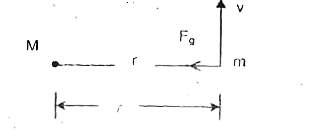
Two massive particles of masses `M` & `m` `(M gt m)` are separated by a distance `l`. They rotate with equal angular velocity under their gravitational attraction. The linear speed of the particle of mass `m` is

A

`sqrt((GMm)/((M+m)l))`

B

`sqrt((GM^(2))/((M+m)l))`

C

`sqrt((Gm)/(l))`

D

`sqrt((Gm^(2))/((M+m)l))`

Text Solution

Verified by Experts

The correct Answer is:
B

The system rotates about the centre of mass. The gravitational force acting on the particle `m` accelerates it towards the centre of the circular path, which has the radius
`R=(Ml)/(M+m)`
`impliesF=(mv^(2))/(r )implies(GMm)/(l^(2))=(mv^(2))/((Ml)/(M+m))`
`impliesv=sqrt((GM^(2))/((M+m)l))`
Promotional Banner

Similar Questions

Explore conceptually related problems

The escape velocity of a particle of mass 'm'

The escape velocity of a particle of mass m varies as

Two particles of masses m_(1) and m_(2) (m_(1) gt m_(2)) are separated by a distance d. The shift in the centre of mass when the two particles are interchanged.

Three particles of equal mass M each are moving on a circular path with radius r under their mutual gravitational attraction. The speed of each particle is

Two particles of masses m and M are initially at rest at an infinite distance apart. They move towards each other and gain speeds due to gravitational attraction. Find their speeds when the separation between the masses becomes equal to d.

Four particles, each of mass M and equidistant from each other, move along a circle of radius R under the action of their mutual gravitational attraction. The speed of each particle is:

Four particles, each of mass M and equidistant from each other, move along a circle of radius R under the action of their mutual gravitational attraction. The speed of each particle is:

Four particles, each of mass M and equidistant from each other, move along a circle of radius R under the action of their mutual gravitational attraction. The speed of each particle is:

Two particles of mass m and M are initialljy at rest at infinite distance. Find their relative velocity of approach due to gravitational attraction when d is their separation at any instant

Four particles of equal masses M move along a circle of radius R under the action of their mutual gravitational attraction. Find the speed of each particle.

