Home
Class 12
PHYSICS
The gravitational field strength vecE an...

The gravitational field strength `vecE` and gravitational potential `V` are releated as
`vecE=-((deltaV)/(deltax)hati+(deltaV)/(deltay)hatj+(deltaV)/(deltaz)hatk)`

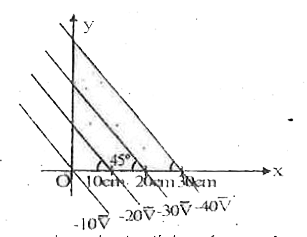
In the figure, transversal lines represent equipotential surfaces. A particle of mass `m` is released from rest at the origin. The gravitational unit of potential , `1vecV=1cm^(2)//s^(2)`
`y`-component of `E` a the point whose co-ordinates are `(4cm,4cm)` is

A

`1cm//s^(2)`

B

`8cm//s^(2)`

C

`4cm//s^(2)`

D

none of these

Text Solution

Verified by Experts

The correct Answer is:

A
Promotional Banner

Similar Questions

Explore conceptually related problems

The gravitational field strength vecE and gravitational potential V are releated as vecE=-((deltaV)/(deltax)hati+(deltaV)/(deltay)hatj+(deltaV)/(deltaz)hatk) In the figure, transversal lines represent equipotential surfaces. A particle of mass m is released from rest at the origin. The gravitational unit of potential , 1vecV=1cm^(2)//s^(2) x -component of the velocity of the particle at the point (4cm,4cm) is

The gravitational field strength vecE and gravitational potential V are releated as vecE=-((deltaV)/(deltax)hati+(deltaV)/(deltay)hatj+(deltaV)/(deltaz)hatk) In the figure, transversal lines represent equipotential surfaces. A particle of mass m is released from rest at the origin. The gravitational unit of potential , 1vecV=1cm^(2)//s^(2) x -component of the velocity of the particle at the point (4cm, 4cm) is

The gravitational field strength vecE and gravitational potential V are releated as vecE=-((deltaV)/(deltax)hati+(deltaV)/(deltay)hatj+(deltaV)/(deltaz)hatk) In the figure, transversal lines represent equipotential surfaces. A particle of mass m is released from rest at the origin. The gravitational unit of potential , 1vecV=1cm^(2)//s^(2) Speed of the particle (v) ( y is in cm and v in cm/s) as function of its y -co-ordinate is

The gravitational field strength vecE and gravitational potential V are releated as vecE=-((deltaV)/(deltax)hati+(deltaV)/(deltay)hatj+(deltaV)/(deltaz)hark) In the figure, transversal lines represent equipotential surfaces. A particle of mass m is released from rest at the origin. The gravitational unit of potential , 1vecV=1cm^(2)//s^(2) Speed of the particle (v) ( y is in cm and v is in cm//s) as function of its y-co ordinate is

A particle of mass 1 kg is released from rest at a point where gravitational potential is 5 J/kg. After some time, it passes through a point B with a speed of 1 m/s. What is the gravitational potential at B ?

We know that electric field (E ) at any point in space can be calculated using the relation vecE = - (deltaV)/(deltax)hati - (deltaV)/(deltay)hatj - (deltaV)/(deltaz)hatk if we know the variation of potential (V) at that point. Now let the electric potential in volt along the x-axis vary as V = 2x^2 , where x is in meter. Its variation is as shown in figure Draw the variation of electric field (E ) along the x-axis.

We know that electric field (E ) at any point in space can be calculated using the relation vecE = - (deltaV)/(deltax)hati - (deltaV)/(deltay)hatj - (deltaV)/(deltaz)hatk if we know the variation of potential (V) at that point. Now let the electric potential in volt along the x-axis vary as V = 2x^2 , where x is in meter. Its variation is as shown in figure A charge particle of mass 10 mg and charge 2.5 muC is released from rest at x = 2 m . Find its velocity when it crosses origin.

Infinite number of bodies, each of mass 2kg are situated on X-axis at distance 1m,2m,4m,8m, respectively from the origin, What is the resulting gravitational potential due to this system at the origin ?

Two point masses m and 2m are kept at points A and B as shown. E represents magnitude of gravitational field strength and V the gravitational potential. As we move from A to B

Infinite number of bodies, each of mass 2kg , are situated on x -axis at distance 1m,2m,4m,8m......... respectively, from the origin. The resulting gravitational potential due to this system at the origin will be
