Home
Class 12
PHYSICS
The motion of a planet around sun in an ...

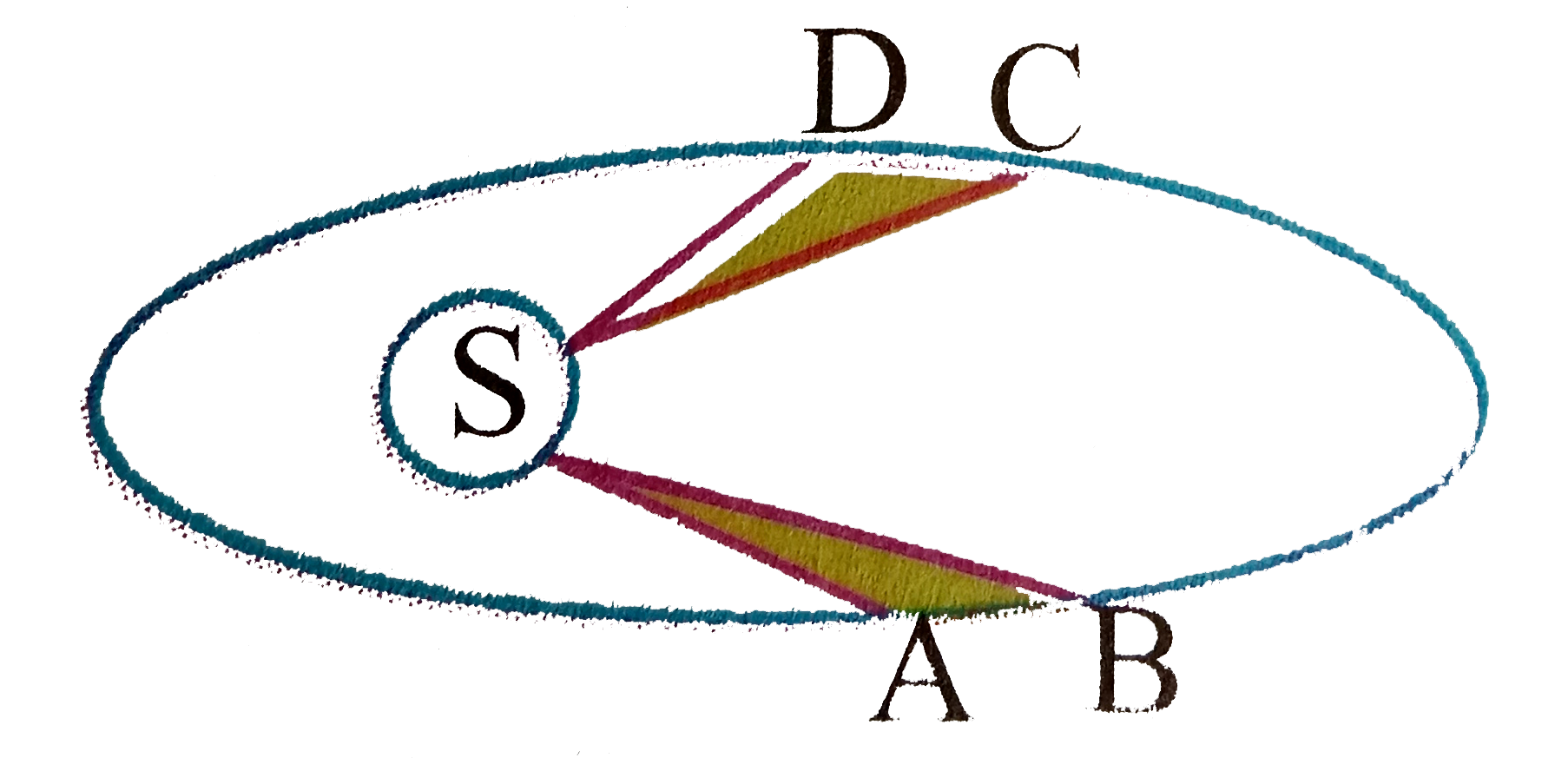
The motion of a planet around sun in an elliptical orbit is shown in the following figure. Sun is situated at one focus. The shaded areas are equal. If the planet takes time `t_1` and `t_2` in moving from `A` to `B` and from `C` to `D` respectively, then

A

`-(3GMm)/(4a)`

B

`-(3GMm)/(8a)`

C

`-(GMm)/(5a)`

D

none of these

Text Solution

Verified by Experts

The correct Answer is:

C
Promotional Banner

Similar Questions

Explore conceptually related problems

A planet is moving round the sun in an elliptical orbit as shows. As the planet moves from A to B

Figure shows the elipticla path of a planet about the sun. The two shaded parts have equal area. If t_1 and t_2 be the tim taken by the planet to go from a to b and from c to d respectively

Figure shows the motion of a planet around the Sun S in an elliptical orbit with the Sun at the focus. The shaded areas A and B are also shown in the figure which can be assumed to be equal. If t_(1) and t_(2) represent the time taken for the planet to move from a to b and c to d , respectively then

Figure shows the motion of a planet around the Sun S in an elliptical orbit with the Sun at the focus. The shaded areas A and B are also shown in the figure which can be assumed to be equal. If t_(1) and t_(2) represent the time taken for the planet to move from a to b and c to d , respectively then

A planet is revolving in an elliptical orbit around the sun as shown in the figure. The areal velocity (area swapped by the radius vector with respect to sun in unit time) is:

Consider a planet moving around a star in an elliptical orbit with period T. Area of elliptical orbit is proportional to

A planet is revolving around the sun in an elliptical orbit having eccentricity e (= (pi)/(4)) . If the time period of revolution is 16 months then find the time taken by the planet in going from A to B in months.

The figure shows elliptical orbit of a planet m about the sun S. the shaded area SCD is twice the shaded area SAB. If t_(1) be the time for the planet to move from C to D and t_(2) is the time to move from A to B, then:

The figure shows elliptical orbit of a planet m about the sun S. the shaded area SCD is twice the shaded area SAB. If t_(1) be the time for the planet to move from C to D and t_(2) is the time to move from A to B, then:

In the figure shown a planet moves in an elliptical orbit around the sun. Compare the speeds, linear and angular momenta at the points A and B .
