Home
Class 12
PHYSICS
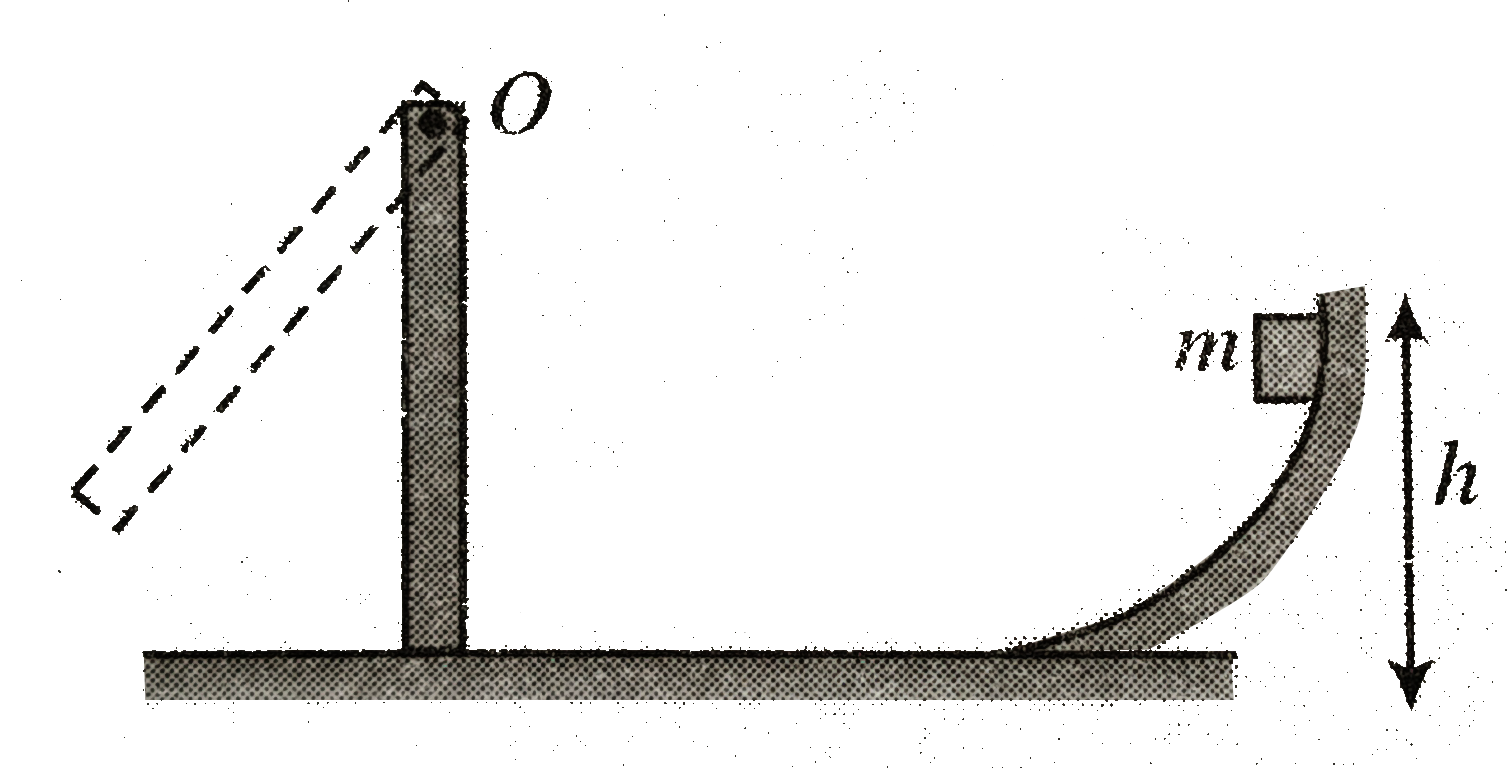
In the shown figure a mass m slides down...

In the shown figure a mass `m` slides down the frictionless surface from height `h` and collides with the uniform vertical rod of length `L` and mass `M` after collision the mass `m` sticks to the rod. The rod is face to rotate in a vertical plane about fixed axis through `O`. Find the maximum angular deflection of the rod from its initial position.

Text Solution

Verified by Experts

Just before collision, velocity of the mass m is along the horizontal and is equal to `V_(0) = sqrt(2gh)`
From the FBD during the collision, we note that net torque of FBD during collision impulses about O = 0
`therefore` The angular momentum of the system about O is conserved. If `L_(1) and L_(2)` are the angular momentum of the system just before and just after the collision, then
`L_(1) = mv_(0)L and L_(2) = Iomega = ((ML^(2))/(3) + mL^(2))omega`

By law of conservation of angular momentum,
`((M)/(3) + m)L^(2)omega = mv_(0)L`
`rArr" "omega = (mv_(0))/(((M)/(3)+m)L)`

Let the rod deflects through an angle `theta`
Initial energy of rod and mass system `= (1)/(2)Iomega^(2),"where I" = ((ML^(2))/(3)+mL^(2))`
Gain in potential energy of the system
`= mgL [1-cos theta]+ "Mg" (L)/(2)[1-cos theta] = (m + (M)/(2))gL (1-cos theta)`
`because` From law of conservation of energy,
`(1)/(2)I omega^(2) = (m + (M)/(2))gL (1-cos theta)`
`rArr" "(1)/(2)((ML^(2))/(3)+mL^(2))xx (m^(2)v_(0)^(2))/(((M)/(3)+m)^(2)L^(2))=(m + (M)/(2))gL (1-cos theta)`
`rArr" "(1)/(2) (m^(2)v_(0)^(2))/([(M)/(3)+m])=(m+(M)/(2))gL(1-cos theta)`
`therefore" "cos theta = 1 - (1)/(2) (m^(2)v_(0)^(2))/([(M)/(3) + m][(M)/(2) + m]gL)`
`rArr" "theta = cos^(-1) [1-(mgh)/({(M//3)+m}{(M//2)+m}gL)]`
Promotional Banner

Similar Questions

Explore conceptually related problems

A L shaped rod of mass M is free to rotate in a vertical plane about axis A A as shown in figure. Maximum angular acceleration of rod is

Two uniform thin rods each of length L and mass m are joined as shown in the figure. Find the distance of centre of mass the system from point O

A uniform rod of length l and mass m is free to rotate in a vertical plane about A as shown in Fig. The rod initially in horizontal position is released. The initial angular acceleration of the rod is

A mass m is at a distance a from one end of a uniform rod of length l and mass M. Find the gravitational force on the mass due to the rod.

A uniform rod of length L is free to rotate in a vertical plane about a fixed horizontal axis through B . The rod begins rotating from rest. The angular velocity omega at angle theta is given as

A uniform rod of mass m and length L is free to rotate in the vertical plane about a horizontal axis passing through its end. The rod initially in horizontal position is released. The initial angular acceleration of the rod is:

A unifrom rod of length l and mass m is free to rotate in a vertical plane about A , Fig. The rod initially in horizontal position is released. The initial angular acceleration of the rod is (MI "of rod about" A "is" (ml^(2))/(3))

A mass m is at a distance a from one end of a uniform rod of length l and mass M. Find the gravitational force on the mass due to tke rod.

The moment of inertia of a thing uniform rod of length L and mass M , about axis CD (as shown in figure) is

A uniform rod AB of length l and mass m hangs from point A in a car moving with velocity v_(0) on an inclined plane as shown in Fig. The rod can rotate in vertical plane about the axis at point A . if the car suddenly stops, the angular speed with which the rod starts rotating is

