Home
Class 12
PHYSICS
A cylindrical drum, pushed along by a bo...

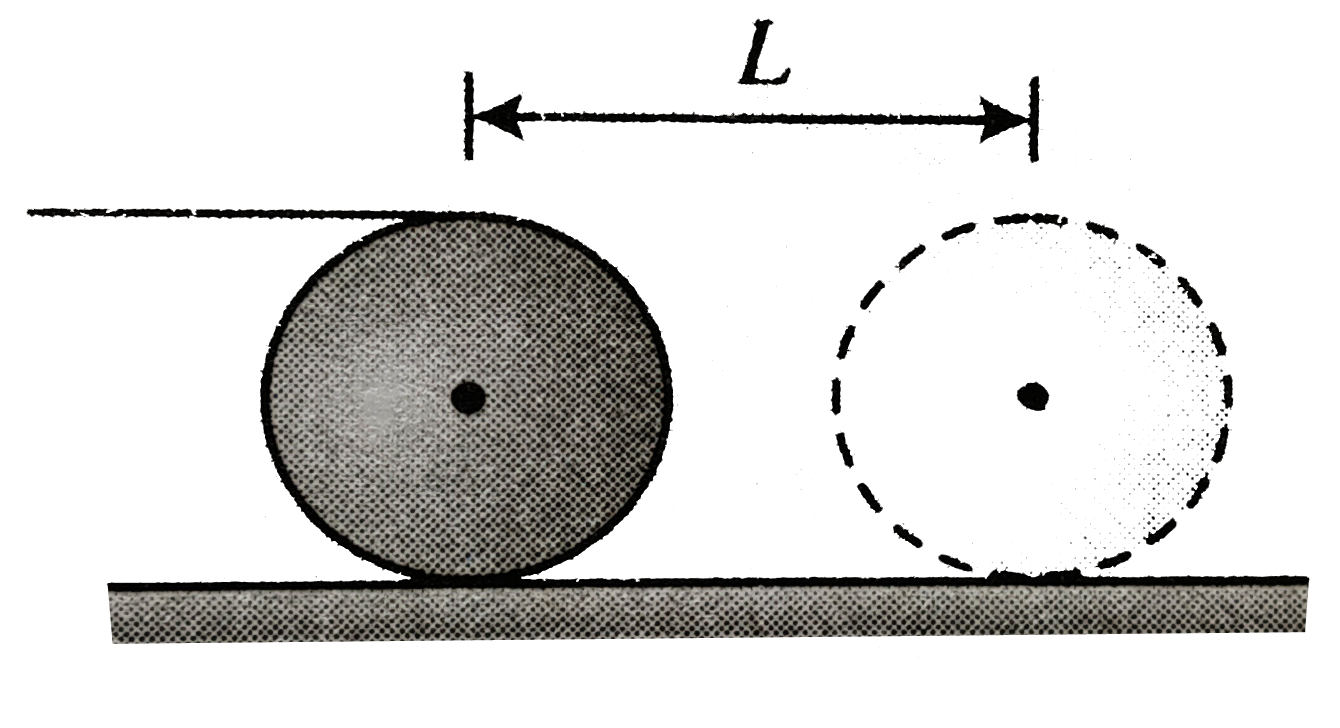
A cylindrical drum, pushed along by a board rolls forward on the ground. There is no slipping at any contact. Find the distance moved by the man whose is pushing the board, when axis of the cylinder covers a distance `L`.

Text Solution

Verified by Experts

Let `v_(0)` be the linear speed of the axis of the cylinder and `omega` be its angular speed about the axis. As it does not slip on the ground hence `omega = (v_(0))/(R)`, where R is the radius of the cylinder.
Speed of the topmost point is `v = v_(0) + omega R = 2 v_(0)`
Time taken by the axis to move a distance L is equal to `t = L//v_(0)`
In the same interval of time distance moved by the topmost point is
`S = 2 v_(0) xx (L)/(v_(0)) = 2L`
As there is no slipping between any point of contact hence distance moved by the man is 2L.
Promotional Banner

Similar Questions

Explore conceptually related problems

A cylindrical drum, pushed along by a board rolls forward on the ground. There is no slipping at any contact. The distance moved by the man who is pushing the board, when axis of the cylinder covers a distance L will be.

A bobbin is pushed along on a rough stationary horizontal surface as shown in the figure. The board is kept horizontal and there is no slipping at any contact points. The distance movedby the board when distance moved by the axis of the bobbin is l is .

Consider a cylinder of mass M and radius R lying on a rough horizontal plane. It has a plank lying on its top as shown in the figure. A force F is applied on the plank such that the plank moves and causes the cylinder to roll. The plank always remains horizontal. There is no slipping at any point to contact. (a) what are the directions of the fricition forces acting at A and B on the plank and the cylinder ? (b) Calculate the acceleration of the cylinder. (c ) Find the value of frictional force at A & B .

A man pushes a cylinder of mass m_1 with the help of a plank of mass m_2 as shown in figure. There in no slipping at any contact. The horizontal component of the force applied by the man is F. (a) the acceleration fo the plank and the center of mass of the cylinder, and (b) the magnitudes and direction of frictional force at contact points.

A very long, solid insulating cylinder with radius R has a cylindrical hole with radius a bored along its entire length. The axis of the hole is at a distance b from the axis of the cylinder, where altbltR (as shown in figure). The solid material of the cylinder has a uniform volume charge density rho . Find the magnitude and direction of the electric field inside the hole, and show that this is uniform over the entire hole. .

A man moves 4 m along east direction, then 3m along north direction, after that he climbs up a pole a height 12m. Find the distance covered by him and his displacement.

A 70 kg man stands in contact against the wall of a cylindrical drum of radius 3 m rotating about its vertical axis with 200 rev/min. The coefficient of friction between the wall and his clothing is 0.15. What is the minimum rotational speed of the cylinder to enable the man to remain stuck to the wall (without falling) when the floor is suddenly removed ?

A uniform solid cylinder of mass 2 kg and radius 0.2 m is released from rest at the top of a semicircular track of radius 0.7 m cut in a block of mass M = 3 kg as shown in Fig. The block is resting on a smooth horizontal surface and the cylinder rolls down without slipping. Based on the above information, answer the following questions: The distance moved by the block when the cylinder reaches the bottom of the track is

A sphere starts rolling down can incline of inclination theta. Find the speed of its centre when it has covered a distance l.

A small particle of mass m moving inside a heavy, hollow and straight tube along the tube axis undergoes elastic collision at two ends. The tube has no friction and it is closed at one end by a flat surface while the other end is fitted with a heavy movable flat piston as shown in figure. When the distance of the piston from closed end is L = L_0 the particle speed is v = v_0 The piston is moved inward at a very low speed V such that V

