Home
Class 12
PHYSICS
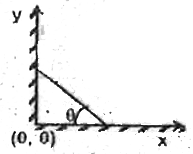
A light rigid rod of length l is constra...

A light rigid rod of length l is constrained to move in a vertical plane, so that its ends are along the x and y axes respectively. Find the instantaneous axis of rotation of the rod when it makes an angle `theta` with horizontal.

Text Solution

Verified by Experts

When the rod inclines at an angle `theta` with vertical, let the contact forces at A & B are `N_(A) & N_(B)` respectively as shown in the figure.
`rArr` Equation of motion of c.m. of the rod can be given by,
`F_(x) = ma_(x) " "rArr" "N_(A) = ma_(x)" "...(i)`
& `F_(y) = ma_(y)" "N_(B) - mg = ma_(y)" "...(ii)`
where `a_(x) & a_(y)` are the horizontal & vertical acceleration of the c.m. of the rod respectively. The moment of `N_(A) & N_(B)` anticlockwise about G is given by [G is COM of rod]
`tau(G) = -N_(A) (l//2) cos theta + N_(B) (l//2) sin theta`
`rArr" "tau_(G) = I_(G) alpha,"where I"_(G)` = M.I. of the rod about G.
`I_(G) = ml^(2)//12 and alpha` = angular accleration of the rod `=(d^(2)theta)/(dt^(2))`
`rArr" "(-N_(A) cos theta + N_(B) sin theta) l//2 = ml^(2) alpha //12" "...(iii)`

Now we have three equations and four unknowns `N_(A), N_(B), a_(x) & a_(y)`. Therefore we need another two equations by using kinematics, x = (l/2) sin `theta` & y = (l/2) cos `theta`, by differentiating x and y, we obtain
`a_(x) = (d^(2)x)/(dt^(2))=(l)/(2) (alpha sin theta - omega^(2) cos theta)" "...(iv)`
`a_(y) = (d^(2)y)/(dt^(2)) =-(l)/(2)(alpha sin theta + omega^(2) cos theta)" "...(v)`
Using (i) & (iv), find `N_(A)` & using (ii) & (v) find `N_(B)`, then put `N_(A) & N_(B)` in equation (iii) to obtain `alpha = (3g//2l) sin theta`
Putting `alpha = omega (d omega)/(d theta)` we obtain,
`omega d omega = (3g)/(2l) sin theta d theta rArr int_(0)^(omega) omega d omega = (3g)/(2l) int_(0)^(theta) sin theta " "rArr omega = sqrt((3g(1-cos theta))/(l))`
Alter
`I = (ml^(2))/(12) + (ml^(2))/(4) " "(because y = l//2)`
`I = (ml^(2))/(3)`
By law of energy conservation,
`(1)/(2)I omega^(2) = "mg" (l)/(2)(1-cos theta) rArr omega = sqrt((3g)/(l)(1-cos theta))`
`alpha = (domega)/(dt) = (3g)/(2l) sin theta`
Promotional Banner

Similar Questions

Explore conceptually related problems

A rod of length l is given two velocities v_(1) and v_(2) in opposite directions at its two ends at right angles to the length. The distance of the instantaneous axis of rotation from v_(1) is

Figure shows a rod of length l resting on a wall and the floor. Its lower end A is pulled towards left with a constant velocity v. Find the velocity of the other end B downward when the rod makes an angle theta with the horizontal.

A rod of length l is moving in a vertical plane ( x-y ) when the lowest point A of the rod is moved with a velocity v . find the a angular velocity of the rod and b velocity of the end B .

A slender uniform rod of mass M and length l is pivoted at one end so that it can rotate in a vertical plane, Fig. There is negligible friction at the pivot. The free end is held vertically above the pivot and then released. The angular acceleration of the rod when it makes an angle theta with the vertical is

A uniform thin rod of mass m and length l is standing on a smooth horizontal suface. A slight disturbance causes the lower end to slip on the smooth surface and the rod starts falling. Find the velocity of centre of mass of the rod at the instant when it makes an angle theta with horizontal.

AB is a mass less rigid rod of length 2l. It is free to rotate in vertical plane about a horizontal axis passing through its end A. Equal point masses (m each) are stuck at the centre C and end Bof the rod. The rod is released from horizontal position. Write the tension in the rod when it becomes vertical.

A uniform rod of length L is free to rotate in a vertical plane about a fixed horizontal axis through B . The rod begins rotating from rest. The angular velocity omega at angle theta is given as

A thin rod MN free to rotation in the vertical plane about the fixed end N is held horizontal when the end M is released the speed of this end when the rod makes an angle alpha with the horizontal will be proportional to : (see figure)

A uniform rod of mass m and length l_(0) is rotating with a constant angular speed omega about a vertical axis passing through its point of suspension. Find the moment of inertia of the rod about the axis of rotation if it make an angle theta to the vertical (axis of rotation).

A rigid rod of mass m & length l is pivoted at one of its ends. If it is released from its horizontal position, find the speed of the centre of mass of the rod when it becomes vertical.

