Home
Class 12
PHYSICS
A composite rod of mass 2m and length 2l...

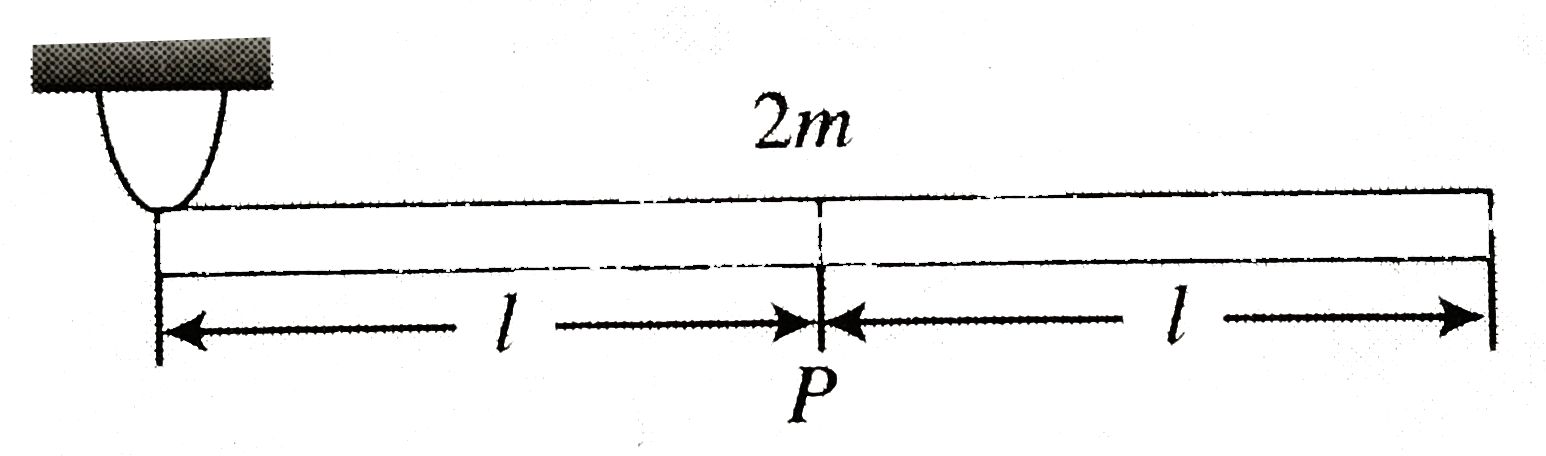
A composite rod of mass `2m` and length `2l` comprises two indentica rods joined end to end at `P`. The composite rod hinged at one of its ends is kept horizontal as shown in the figure. If it is realeased from rest.

a. find its angular speed when it becomes vertical.
b. If the lower rod gets detached with the upper rod due to centrifugal effect at their joint `P`, at the vertical position of the composite rod, find their linear and angular velocities just after their separation.

Text Solution

Verified by Experts

(a) Suppose that the composite rod acquires an angular speed `omega` when it reaches its vertical position. Its centre of mass G moves from `G_(1)"to" G_(2)`. Therefore the potential energy of the composite rod decreases by 2mgh where h = l.
Applying conservation of energy, `(1)/(2) I omega^(2) = (2m) gl`
where I = M.I. of the composite rod about O
`= (2m) (2l)^(2)//3 = 8m l^(2)//3`
`rArr omega = sqrt((3)/(2)(g)/(l))`

(b) Referring to fig. we can see that, just at the vertical position, during the break, the weights of the component rods 1 & 2, the reaction force R at the pivot & the reaction forces N at the joint of the rods, pass through the pivot O. Therefore these forces can not produce any moment about O, that means the rods do not experience any horizontal force and torque during breaking. At vertical position, the angular momentum of the system about O remains same as just after the breaking.
We can also argue that, the angular momentum of each rod remains constant just before & after breaking. The radial forces cannot produce any moment about the centre of mass of the rods 1 & 2 in the vertical position. The linear velocity of the c.m. of the rods remains constant.
`rArr" "omega_(1) = omega`
`v._(1) = v_(1) = omega l//2" "{"for rod 1"}`
`omega_(2) = omega, v._(2) = v_(2) = (3//2) omega l" "{"for rod 2"}`
`rArr" "omega_(1) = omega_(2) = sqrt((3g)/(2l)), v_(1) = (1)/(2) sqrt((3gl)/(2)) gl and v_(2) = (3)/(2) sqrt((3gl)/(2))`
Promotional Banner

Similar Questions

Explore conceptually related problems

A rod PQ of mass M and length L is hinged at end P . The rod is kept horizontal by a massless string tied to point Q as shown in the figure. When string is cut, the initial angular accleration of the rod is.

One end of a uniform rod of length l and mass m is hinged at A. It is released from the rest from horizontal position AB as shown in figure. The force exerted by the rod on the hinge when it becomes verticle is

A rigid rod of mass m & length l is pivoted at one of its ends. If it is released from its horizontal position, find the speed of the centre of mass of the rod when it becomes vertical.

A rod AB of mass M and length L is shown in figure. End A of rod is hinged and end B is lying on the ground. Find the Horizontal component of the force applied by the hinge

A rod of mass m and length L is hinged at its top end. If the rod is in equilibrium making an angle of 30^(@) with the vertical when a horizontal force F is applied as shown in figure, then the value of F is:

A uniform rod of length l is from rest such that it rotates about a smooth pivot. The angular speed of the rod when it becomes vertical is. .

A rod AB of mass M and length L is shown in figure. End A of rod is hinged and end B is lying on the ground. Find the Normal reaction by ground on the rod

A rod PQ of mass M and length L is hinged at end P. The rod is kept horizontal by a massless string tied to point Q as shown in figure. When string is cut, the intial angular acceleration of the rod is

A thin rod of mass m and length l is hinged at the lower end to a level floor and stands vertically. Then its upper end will strike the floor with a velocity given by:

A uniform rod of length 50 cm is released in the vertical plane from the position shown in the figure. The rod is hinged smoothly at O. The angular speed of rod when it becomes horizontal is ( take g = 10m s^(-2) )

