Home
Class 12
PHYSICS
AB is a mass less rigid rod of length 2l...

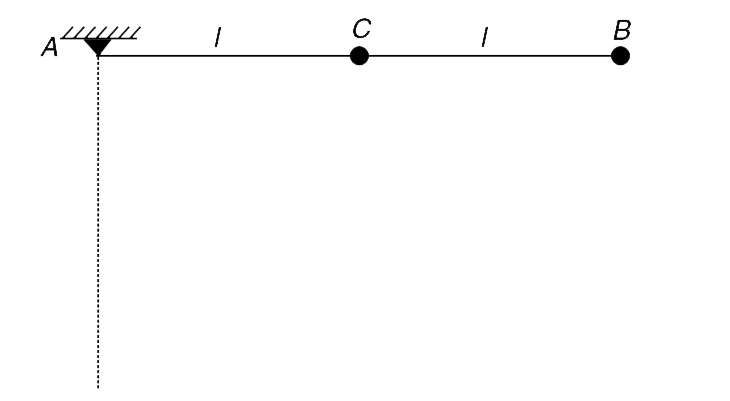
AB is a mass less rigid rod of length 2l. It is free to rotate in vertical plane about a horizontal axis passing through its end A. Equal point masses (m each) are stuck at the centre C and end Bof the rod. The rod is released from horizontal position. Write the tension in the rod when it becomes vertical.

Text Solution

Verified by Experts

The correct Answer is:

`(A) rarr (q), (B) rarr (q), (C) rarr (p), (D) rarr (q)`
Promotional Banner

Similar Questions

Explore conceptually related problems

A uniform rod of mass m and length L is free to rotate in the vertical plane about a horizontal axis passing through its end. The rod initially in horizontal position is released. The initial angular acceleration of the rod is:

A rigid rod of mass m & length l is pivoted at one of its ends. If it is released from its horizontal position, find the speed of the centre of mass of the rod when it becomes vertical.

A uniform rod of length L is free to rotate in a vertical plane about a fixed horizontal axis through B . The rod begins rotating from rest. The angular velocity omega at angle theta is given as

A thin uniform rod of mass M and length L is free to rotate in vertical plane about a horizontal axis passing through one of its ends. The rod is released from horizontal position shown in the figure. Calculate the shear stress developed at the centre of the rod immediately after it is released. Cross sectional area of the rod is A. [For calculation of moment of inertia you can treat it to very thin]

In the figure shown one end of a light spring of natural length l_(0)=sqrt(5/8)m(~~0.8m) is fixed at point D and other end is attached to the centre B of a uniform rod AF of length l_(0)//sqrt(3) and mass 10kg. The rod is free to rotate in a vertical plane about a fixed horizontal axis passing through the end A of the rod. The rod is held at rest in horizontal position and the spring is in relaxed state. It is found that, when the rod is released to move it makes an angle of 60^(@) with the horizontal when it comes to rest for the first time. Find the (a) the maximum elogation in the spring . (Approximately) (b) the spring constant. (Approximately)

In the figure given in the text if mass of the rod is m then find hinge force. (a). Just after the rod is released from the horizontal position. (b). When rod becomes vertical

A thin homogeneous rod of mass m and length l is free to rotate in vertical plane about a horizontal axle pivoted at one end of the rod. A small ballof mass m and charge q is attached to the opposite end of this rod. The whole system is positioned in a horizontal electric field of magnitude E=(mg)/(2q) . The rod is released from, shown position from rest. What is the speed of ball when rod becomes vertical?

A uniform rod of length l and mass m is free to rotate in a vertical plane about A as shown in Fig. The rod initially in horizontal position is released. The initial angular acceleration of the rod is

A thin homogeneous rod of mass m and length l is free to rotate in vertical plane about a horizontal axle pivoted at one end of the rod. A small ballof mass m and charge q is attached to the opposite end of this rod. The whole system is positioned in a horizontal electric field of magnitude E=(mg)/(2q) . The rod is released from, shown position from rest. What is the angular acceleration of the rod at the instant of releasing the rod?

A thin homogeneous rod of mass m and length l is free to rotate in vertical plane about a horizontal axle pivoted at one end of the rod. A small ballof mass m and charge q is attached to the opposite end of this rod. The whole system is positioned in a horizontal electric field of magnitude E=(mg)/(2q) . The rod is released from, shown position from rest. What is the acceleration of the small ball at the instant of releasing the rod?
