Home
Class 12
PHYSICS
A uniform rod AB which is free to swing ...

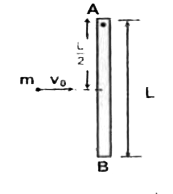
A uniform rod AB which is free to swing in the vertical plane about a horizontal axis through A, is hanging freely. A particle of equal mass strikes the rod with a velocity `v_(0)` and gets stucks to it. Find the angular velocity of the combination immediately after the collision.

Text Solution

Verified by Experts

The correct Answer is:

`omega = (6 V_(0))/(7L)` (anticlockwise)
Promotional Banner

Similar Questions

Explore conceptually related problems

A uniform rod of mass M and length L, which is free to rotate about a fixed vertical axis through O, is lying on a frictionless horizontal table. A particle of equal mass strikes the rod with a velocity V_(0) and sticks to it. The angular velocity of the combination immediately after the collision is:

A wooden log of mass M and length L is hinged by a frictionless nail at O.A bullet of mass m strikes with velocity v and sticks to it. Find angular velocity of the system immediately after the collision aboutO.

A uniform rod of length L is free to rotate in a vertical plane about a fixed horizontal axis through B . The rod begins rotating from rest. The angular velocity omega at angle theta is given as

A uniform rod of legth L is free to rotate in a vertica plane about a fixed horizontal axis through B . The rod begins rotating from rest. The angular velocity omega at angle theta is given as

A uniform rod AB of length L and mass M is lying on a smooth table. A small particle if mass m strike the rod with velocity v_(0) at point C at a distance comes to rest after collision. Then find the value of x , so that point A of the rod remains stationary just after collision. .

A rod of length l forming an angle theta with the horizontal strikes a frictionless floor at A with its centre of mass velocity v_(0) and no angular velocity. Assuming that the impact at A is perfectly elastic. Find the angular velocity of the rod immediately after the impact.

A thin rod of mass 0.9 kg and length 1 m is suspended, at rest, from one end so that it can freely oscillate in the vertical plane. A particle of mass 0.1 kg moving in a straight line with velocity 80 m/s hits the rod at is bottom most point and sticks to it (see figure) . The angular speed ( in rad/s) of the rod immediately after the collision will be .

A uniform rod of mass m and length L is free to rotate in the vertical plane about a horizontal axis passing through its end. The rod initially in horizontal position is released. The initial angular acceleration of the rod is:

A uniform rod AB of mass 3m and length 4l, which is free to turn in a vertical plane about a smooth horizontal axis through A, is released from rest when horizontal. When the rod first becomes vertical, a point C of the rod, where AC=3l strikes a fixed peg. Find the linear impulse exerted by the peg on the rod if (a). The rod is brought to rest by the peg. (b). The rod rebounds and next comes to instantaneous rest inclined to the downward vertical at an angle (pi)/(3) radian.

A L shaped rod of mass M is free to rotate in a vertical plane about axis A A as shown in figure. Maximum angular acceleration of rod is
