Home
Class 12
PHYSICS
The free end of a thread wound on a bobb...

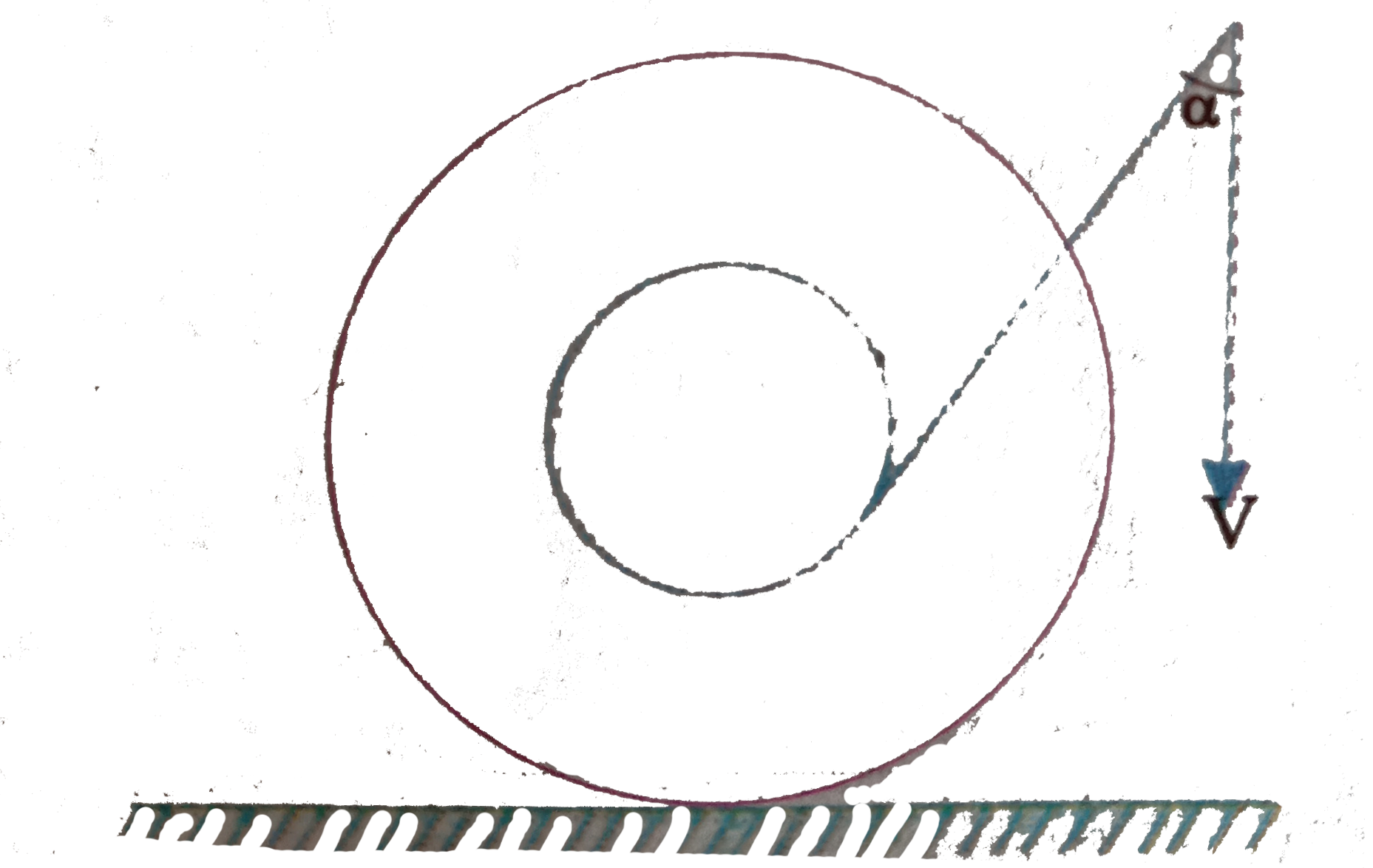
The free end of a thread wound on a bobbin is passed round a nail A hammered into the wall. The thread is pulled at a constant velocity 'v' . Assuming pure rolling of bobin, find the velocity `v_(0)` of the centre of the bobbin at the instant when the thread forms an angle `alpha` with the vertical: (`R` and `r` are outer and inner radii off the babbin)

Text Solution

Verified by Experts

The correct Answer is:

`(Rv)/(R sin alpha - r)`
Promotional Banner

Similar Questions

Explore conceptually related problems

Figure shows a rod of length l resting on a wall and the floor. Its lower end A is pulled towards left with a constant velocity v. Find the velocity of the other end B downward when the rod makes an angle theta with the horizontal.

A thin hoop of mass M and radius r is placed on a horizontal plane. At the initial instant, the hoop is at rest. A small washer of mass m with zero initial velocity slides from the upper point of the hoop along a smooth groove in the inner surfaces of the hoop. Determine the velocity u of the centre of the hoop at the moment when the washer is at a certain point A of the hoop, whose radius vector forms an angle phi with the vertical (figure). The friction between the hoop and the plane should be neglected

A uniform circular loop of radius a and resistance R is pulled at a constant velocity v out of a region of a uniform plane of the loop and the velocity are both perpendicular to B. Then the electrical power in the circular loop at the instant when the arc (of the circular loop) outside the region of magnetic field subtends an angle (pi)/(3) at the centre of the loop is

A projectile, thrown with velocity v_(0) at an angle alpha to the horizontal, has a range R. it will strike a vertical wall at a distance R//2 from the point of projection with a speed of

A particle of mass m moves along the internal smooth surface of a vertical cylinder of the radius R. Find the force with which the particle acts on the cylinder wall if at the initial moment of time its velocity equals v_(0) . And forms an angle alpha with the horizontal.

A disk is fixed at its centre O and rotating with constant angular velocity omega . There is a rod whose one end is connected at A on the disc and the other end is connected with a ring which can freely moce along the fixed vertical smooth rod. At an instant when the rod is making an angle 30^(@) with the vertical the ring is found to have a velocity v in the upward direction. Find omega of the disk. Given that the point A is R//2 distance above point O and length of the rod Ab is l

A conducting circular loop of radius a and resistance per unit length R is moving with a constant velocity v_0 , parallel to an infinite conducting wire carrying current i_0 . A conducting rod of length 2a is approaching the centre of the loop with a constant velocity v_0/2 along the direction 2 of the current. At the instant t = 0 , the rod comes in contact with the loop at A and starts sliding on the loop with the constant velocity. Neglecting the resistance of the rod and the self-inductance of the circuit, find the following when the rod slides on the loop. (a) The current through the rod when it is at a distance of (a/2) from the point A of the loop. (b) Force required to maintain the velocity of the rod at that instant.

A uniform ring of radius R is given a back spin of angular velocity V_(0)//2R and thrown on a horizontal rough surface with velocity of centre to be V_(0) . The velocity of the centre of the ring when it starts pure rolling will be

A sphere of mass M and radius r shown in figure slips on a rough horizontal plane. At some instant it has translational velocity V_(0) and rotational velocity about the centre (v_(0))/(2r) . Find the translational velocity after the sphere starts pure rolling. .

A sphere of mass M and radius r shown in the figure on a rough horizontal plane. At some instant it has translational velocity v_(0) , and rotational velocity about centre v_(0)//2r . The percentage change of translational velocity after the sphere start pure rolling:
