Home
Class 12
PHYSICS
A circular disc of mass M(1) and radius ...

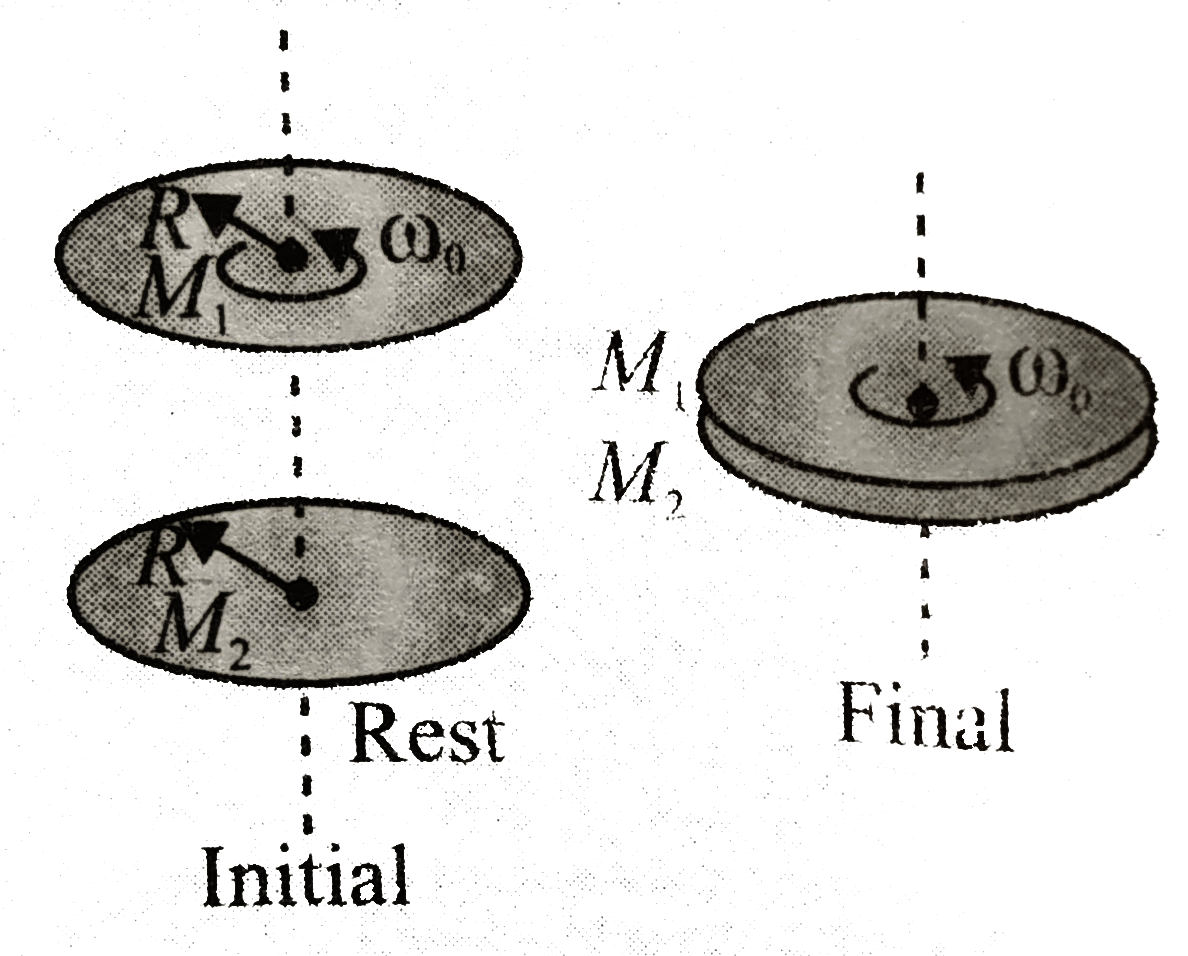
A circular disc of mass `M_(1)` and radius `R`, initially moving, With a constant angular speed `omega` is gently placed coaxially on a stationary circular disc of mass ` M_(2)` and radius `R`, as shown in Fig. There is a frictional force between the two discs.
If disc `M_(2)` is placed on a smooth surface, then 'determine' the final angular speed of each disc.
b. Determine the work done by friction.
c. Determine the fractional loss in kinetic energy. i.e. `/_\K//K_(i)`

A

`(m_(1))/(m_(2))`

B

`(m_(2))/(m_(1)+m_(2))`

C

`(m_(2))/(m_(1))`

D

`(m_(1))/(m_(1) + m_(2))`

Text Solution

Verified by Experts

The correct Answer is:

B
Promotional Banner

Similar Questions

Explore conceptually related problems

A disc of mass m and radius R rotating with angular speed omega_(0) is placed on a rough surface (co-officient of friction =mu ). Then

A disc of mass M and Radius R is rolling with an angular speed omega on the horizontal plane. The magnitude of angular momentum of the disc about origin is:

A circular disc of mass 2 kg and radius 10 cm rolls without slipping with a speed 2 m/s. The total kinetic energy of disc is

A force F acts tangentially on a part of a uniform disc of mass 'm' and radius 'R' hinged at point O. The force exerted by hinge on the portion of disc initially.

A circular disc of mass M and radius R rotating with speed of omega and another disc of same mass M and radius R/2 placed co axially on first disc, after sometime disc-2 also attain constant speed w_2 . Find loss of percentage in energy

A disc of mass m and radius R moves in the x-y plane as shown in Fig. The angular momentum of the disc about the origin O at the instant shown is

A disc of mass M and radius R moves in the x-y plane as shown in the figure. The angular momentum of the disc at tihe instant shows is

A circular hole of radius R//2 is cut from a circular disc of radius R . The disc lies in the xy -plane and its centre coincides with the origin. If the remaining mass of the disc is M , then a. determine the initial mass of the disc and b. determine its moment of inertia about the z -axis.

A uniform disc of mass M and radius R is hinged at its centre C . A force F is applied on the disc as shown . At this instant , angular acceleration of the disc is

Initial angular velocity of a circular disc of mass M is omega_(1) . Then two small spheres of mass m are attached gently to two diametrically opposite points on the edge of the disc. What is the final angular velocity of the disc -
