Home
Class 12
PHYSICS
A ring of mass m sliding on a smooth sur...

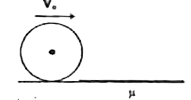
A ring of mass m sliding on a smooth surface with velocity `v_(0)` enters rough surface with coefficient of kinetic friction `mu_(k)`, then

A

the linear distance moved by centre of mass before the ring starts pure rolling is `(3v_(0)^(2))/(8 mu_(k)g)`

B

the gain in kinetic energy is `(mv_(0)^(2))/(8)`

C

the loss in kinetic energy is `(mv_(0)^(2))/(4)`

D

the work done by friction force is `-(3mv_(0)^(2))/(8)`

Text Solution

Verified by Experts

The correct Answer is:

C
Promotional Banner

Similar Questions

Explore conceptually related problems

A rectangular block of size (bbxxh) moving with velocity v_(0) enters on a rough surface where the coefficient of friction is mu as shown in figure. Identify the correct statement.

A block of mass m moving with a velocity v_(0) on a rough horizontal surface from x=0 coefficient of friction is given by mu=mu_(0)+ax . Find the kinetic energy of the block as function of x before it comes to rest.

A block of mass m starts at rest at height on a frictionless inclined plane. The block slides down the plane, travels across a rough horizontal surface with coefficient of kinetic friction mu and compresses a spring with force constant k a distance x before momentarilly coming to rest. Then the spring extends and the block travels back across the rough surface, sliding up the plane. The block travels a total distance d on rough horizontal surface. The correct experssion for the maximum height h' that the block reaches on its return is :

A block of mass m starts at rest at height on a frictionless inclined plane. The block slides down the plane, travels across a rough horizontal surface with coefficient of kinetic friction mu and compresses a spring with force constant k a distance x before momentarilly coming to rest. Then the spring extends and the block travels back across the rough surface, sliding up the plane. The block travels a total distance d on rough horizontal surface. The correct experssion for the maximum height h' that the block reaches on its return is :

A block of mass m is moving on a rough horizontal surface. mu is the coefficient of kinetic friction between the block and the surface. What is the net force exerted by the surface on the block?

A block of mass m is slowly pulled along a curved surface from position 1 and 2. If the coefficient of kinetic friction between the block and surface is mu , find the work done by the applied force.

A small hoop of mass m is given an initial velocity of magnitude v_(0) on the horizontal circular ring of radius 'r' . If the coefficient of kinetic friction is mu_(k) the tangential acceleration of the hoop immediately after is release is ( assume the horizontal ring to be fixed and not in contact with any supporting surface )

A heavy chain with a mass per unite length p is pulled by the constant force F along a horizental surface consisting of a smooth section and a rough section. The chain is initially at rest on the rough surface with x = 0 . If the coefficient of kinetic friction between the chain and the rough surface is mu_(k) determine the velocity v of the chain when x = L . The force F is hreater than mu_(k) ogL in under to initate the motion ,

A uniform ring of mass m is placed on a rough horizontal fixed surface as shown in the figure. The coefficient of friction between the left part of the ring and left part of the horizontal surface is mu_(1)=0.6pi and between right half and the surface is mu_(2)=0.2pi . At the instant shown, now the ring has been imparted an angular velocity in clockwise sense in the figure shown. At this moment magnitude of acceleration of centre O of the ring (in m//s^(2) ) is (take g=10m//s^(2) )

Two blocks of equal masses are connected by an ideal string passing over an ideal pulley as shown in the figure All the surfaces in contact with blocks are rough having coefficient of kinetic friction mu between them. If the blocks slide with constant velocity, find the value of mu
