Home
Class 12
PHYSICS
Two rods AB and BC of equal cross-sectio...

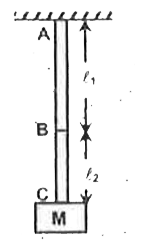
Two rods AB and BC of equal cross-sectional area A and Young's constant `Y_1` and `Y_2` are joined and suspended from a fixed support A. A block of mass M is attached to the lowest point C. The density of the rods is negligibly small. Find displacement of the point C.

Text Solution

Verified by Experts

The correct Answer is:

`(Mg)/A [l_1/y_1+l_2/y_2]`
Promotional Banner

Similar Questions

Explore conceptually related problems

A wire of length l, area of cross-section A and Young,s modulus of elasticity Y is suspended form the roof of a building. A block of mass m is attached at lower end of the wire. If the block is displaced from its mean position and released then the block starts oscillating. Time period of these oscillations will be

A uniform heavy rod of weight W, cross sectional area a and length L is hanging from fixed support. Young modulus of the material of the rod is Y. Neglect the lateral contraction. Find the elongation of the rod.

A rod of length L, cross sectional area A and density rho is hanging from a rigid support by spring of stiffries k. A very small sphere of mass m is rigidly attached at the bottom of the rod. The rod is partially immersed in a liquid of density rho . Find the period of small oscillations.

A steel wire of negligible mass, length 2I , cross sectional area 'A' and Young's modulus 'Y' is held between two rigid walls. A small body of mass 'm' is suspended from its middle point 'O' as shown. The vertical descent of the middle point 'O' of the wire is

A metal rod of length l, cross-sectional area A, Young's modulus Y and coefficient of linear expansion alpha is heated to t^(@)C . The work that can be performed by the rod when heated is

A uniform rod of length l , mass m , cross-sectional area A and Young's modulus Y is rotated in horizontal plane about a fixed vertical axis passing through one end, with a constant angular velocity omega . Find the total extension in the rod due to the tension produced in the rod.

A metal wire of length L_1 and area of cross section A is attached to a rigid support. Another metal wire of length L_2 and of the same cross sectional area is attached to the free end of the first wire. A body of mass M is then suspended from the free end of the second wire, if Y_1 and Y_2 are the Young's moduli of the wires respectively the effective force constant of the system of two wires is

A metal wire of length L_1 and area of cross section A is ttached to a rigid support. Another metal wire of length L_2 and of the same cross sectional area is attached to the free end of the first wire. A body of mass M is then suspended from the free end of the second wire, if Y_1 and Y_2 are the Young's moduli of the wires respectively the effective force constant of the system of two wires is

A cord of mass m length L, area of cross section A and Young's modulus y is hanging from a ceiling with the help of a rigid support. The elogation developed in the wire due to its own weight is

A rod of uniform cross sectional area 5mm^2 weighing 5 kg and length 1 m is suspended vertically from a fixed support the elongation produced in the rod if [Young's modulus of material, Y=2 x 10^11 N/m^2 and g=10 ms^(-2) ]
