Home
Class 12
PHYSICS
Two thin slabs of refractive indices mu(...

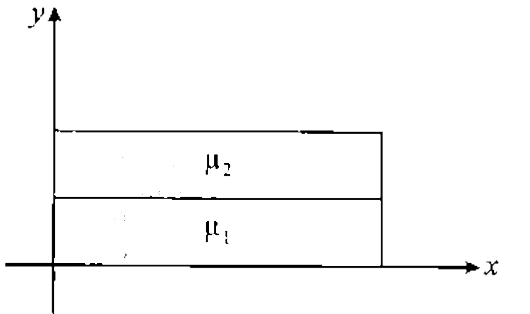
Two thin slabs of refractive indices `mu_(1)` and `mu_(2)` are placed parallel to each other in the x-z plane. If the direction of propagation of a ray in the two media are along the vectors `vec(r)_(1) = a hati +b hatj` and `vec(r)_(2) = c hati +d hatj` then we have:

A

`mu_(1)a=mu_(2)b`

B

`(mu_(1)a)/sqrt(a^(2)+b^(2))=(mu_(2)d)/sqrt(c^(2)+d^(2))`

C

`mu_(1)(a^(2)+b^(2))=mu_(2)(c^(2)+d^(2))`

D

none of these

Text Solution

Verified by Experts

The correct Answer is:

B
Promotional Banner

Similar Questions

Explore conceptually related problems

The xz plane separates two media A and B with refractive indices mu_(1) & mu_(2) respectively. A ray of light travels from A to B . Its directions in the two media are given by the unit vectors, vec(r)_(A)=a hat i+ b hat j & vec(r)_(B)= alpha hat i + beta hat j respectively where hat i & hat j are unit vectors in the x & y directions. Then :

The xz plane separates two media A and B with refractive indices mu_(1) & mu_(2) respectively. A ray of light travels from A to B . Its directions in the two media are given by the unut vectors, vec(r)_(A)=a hat i+ b hat j & vec(r)_(B) alpha hat i + beta hat j respectively where hat i & hat j are unit vectors in the x & y directions. Then :

The x-z plane separates two media A and B of refractive indices mu_(1) = 1.5 and mu_(2) = 2 . A ray of light travels from A to B. Its directions in the two media are given by unit vectors u_(1) = a hat(i)+b hat(j) and u_(2) = c hat(i) +a hat(j) . Then

Given two vectors veca=-hati + 2hatj + 2hatk and vecb =- 2hati + hatj + 2hatk find |vec a xx vec b|

The vector vec c , directed along the internal bisector of the angle between the vectors vec a = 7 hati - 4 hatj - 4hatk and vecb = -2hati - hatj + 2 hatk " with " |vec c| = 5 sqrt(6), is

For what value of x , will the two vector A= 2hati + 2hatj -x hatk and B =2 hati - hatj - 3hatk are perpendicular to each other ?

If two vectors are given as veca = hati - hatj + 2hatk and vecb = hati + 2hatj+hatk , the unit vector perpendicular to both vec a and vec b is

A plane is parallel to the vectors hati+hatj+hatk and 2hatk and another plane is parallel to the vectors hati+hatj and hati-hatk . The acute angle between the line of intersection of the two planes and the vector hati-hatj+hatk is

A force acting on a body displaces it from position vector vec(r_(1))=(2hati-hatj+3hatk)m" to "vec(r_(2))=(5hati-2hatj+4hatk)m . Then find the displacement vector.

The vector parallel to the line of intersection of the planes vecr.(3hati-hatj+hatk) = 1 and vecr.(hati+4hatj-2hatk)=2 is :
