
Home
Class 12
CHEMISTRY
The wave function, Psi("n, l, m(l)) is...

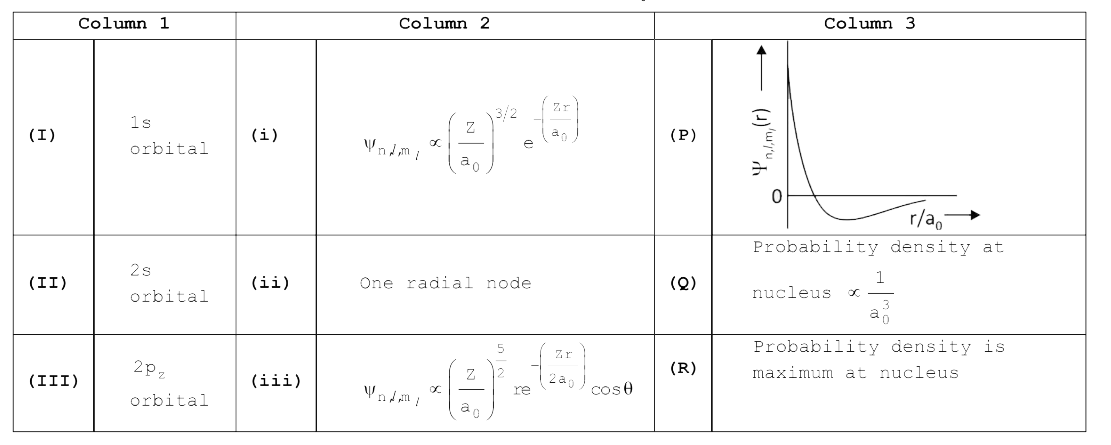
The wave function, `Psi_("n, l, m_(l))` is a mathematical function whose value depends upon spherical polar coordinates `(r, theta,phi)` of the electron and characterized by the quantum numbers n, l and `n_(l)`, Here r is distance from nucleus, `theta` is colatitude and `phi` is azimuth. In the mathematical functions given in the Table, Z is atomic number and `a_(0)` is Bohr radius.


For the given orbital in Column 1, the only CORRECT combination for any hydrogen-like species is:

A

(II)(ii)(Q)

B

(I)(i)(S)

C

(I)(i)(R)

D

(I)(iii)(R)

Text Solution

Verified by Experts

The correct Answer is:

D

1s orbital can not have `theta` function (angular function)
Therefore D is incorrect.
Promotional Banner

Similar Questions

Explore conceptually related problems

The wave function, Psi_("n, l, m_(l)) is a mathematical function whose value depends upon spherical polar coordinates (r, theta,phi) of the electron and characterized by the quantum numbers n, l and n_(l) , Here r is distance from nucleus, theta is colatitude and phi is azimuth. In the mathematical functions given in the Table, Z is atomic number and a_(0) is Bohr radius. For hydrogen atom, the only CORRECT combination is:

The wave function, Psi_("n, l, m_(l)) is a mathematical function whose value depends upon spherical polar coordinates (r, theta,phi) of the electron and characterized by the quantum numbers n, l and n_(l) , Here r is distance from nucleus, theta is colatitude and phi is azimuth. In the mathematical functions given in the Table, Z is atomic number and a_(0) is Bohr radius. For ion, the only INCORRECT combination is:

The wave function psi_(n,l,m) is a mathematical function whose value depends upon spherical polar coordinates (r, theta, phi) of the electron and characterized by the quantum numbers n,l and m . Here r is distance from nucleus theta is colatitude and phi is azimuth. In the mathematical functions given in the Table, Z is atomic number and a_(0) is Bohr radius. For the given orbital in Column 1 the only Correct combination for any hydrogen -like species is

The set of quantum numbers, n = 3, l = 2, m_(l) = 0

How many electrons in an atom may have the quantum numbers n=4 and l=0 ?

The set of quantum numbers, n = 2, l = 2, m_(l) = 0 :

What is the maximum number of electron in an atom that can have the quantum numbers n = 4, m_(l) =+1 ?

The values of quantum numbers n, l and m for the fifth electron of boron is

The total number of electrons in a subshell designated by azimuthal quantum number, l is given as

In an atom, the total number of electrons .having quantum numbers. n = 4 , |m_(l)|=1 is :
