Home
Class 12
CHEMISTRY
In HCP or CCP constituent particles occu...

In HCP or CCP constituent particles occupy 74% of the available space. The remaining space (26%) in between the spheres remains unoccupied and is called interstitial voids or holes. Considering the close packing arrangement, each sphere in the second layer rests on the hollow space of the first layer, touching each other. The void created is called tetrahedral void. If R is the radius of the spheres in the close packed arrangement then,
R (radius of tetrahedral void) = 0.225 R
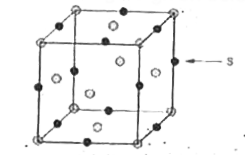
In a close packing arrangement, the interstitial void formed by the combination of two triangular voids of the first and second layer is called octahedral coid. Thus, double triangular void is surrounded by six spheres. The centre of these spheres on joining, forms octahedron. If R is the radius of the sphere. in a close packed arrangement then,
R (radius of octahedral void = 0.414 R).
In the figure given below, the site marked as S is a

A

tetrahedral void

B

cubic void

C

octahedral void

D

None of the above

Text Solution

Verified by Experts

The correct Answer is:

C
Promotional Banner

Similar Questions

Explore conceptually related problems

In HCP or CCP constituent particles occupy 74% of the available space. The remaining space (26%) in between the spheres remains unoccupied and is called interstitial voids or holes. Considering the close packing arrangement, each sphere in the second layer rests on the hollow space of the first layer, touching each other. The void created is called tetrahedral void. If R is the radius of the spheres in the close packed arrangement then, R (radius of tetrahedral void) = 0.225 R In a close packing arrangement, the interstitial void formed by the combination of two triangular voids of the first and second layer is called octahedral coid. Thus, double triangular void is surrounded by six spheres. The centre of these spheres on joining, forms octahedron. If R is the radius of the sphere. in a close packed arrangement then, R (radius of octahedral void = 0.414 R). In Schottky defect

In HCP or CCP constituent particles occupy 74% of the available space. The remaining space (26%) in between the spheres remains unoccupied and is called interstitial voids or holes. Considering the close packing arrangement, each sphere in the second layer rests on the hollow space of the first layer, touching each other. The void created is called tetrahedral void. If R is the radius of the spheres in the close packed arrangement then, R (radius of tetrahedral void) = 0.225 R In a close packing arrangement, the interstitial void formed by the combination of two triangular voids of the first and second layer is called octahedral coid. Thus, double triangular void is surrounded by six spheres. The centre of these spheres on joining, forms octahedron. If R is the radius of the sphere. in a close packed arrangement then, R (radius of octahedral void = 0.414 R). Mark the false statement :

In HCP or CCP constituent particles occupy 74% of the available space. The remaining space (26%) in between the spheres remains unoccupied and is called interstitial voids or holes. Considering the close packing arrangement, each sphere in the second layer rests on the hollow space of the first layer, touching each other. The void created is called tetrahedral void. If R is the radius of the spheres in the close packed arrangement then, R (radius of tetrahedral void) = 0.225 R In a close packing arrangement, the interstitial void formed by the combination of two triangular voids of the first and second layer is called octahedral coid. Thus, double triangular void is surrounded by six spheres. The centre of these spheres on joining, forms octahedron. If R is the radius of the sphere. in a close packed arrangement then, R (radius of octahedral void = 0.414 R). If the anions (A) form hexagonal close packing and cations (C ) occupy only 2/3rd octahedral voids in it, then the general formula of the compound is

In HCP or CCP constituent particles occupy 74% of the available space. The remaining space (26%) in between the spheres remains unoccupied and is called interstitial voids or holes. Considering the close packing arrangement, each sphere in the second layer rests on the hollow space of the first layer, touching each other. The void created is called tetrahedral void. If R is the radius of the spheres in the close packed arrangement then, R (radius of tetrahedral void) = 0.225 R In a close packing arrangement, the interstitial void formed by the combination of two triangular voids of the first and second layer is called octahedral coid. Thus, double triangular void is surrounded by six spheres. The centre of these spheres on joining, forms octahedron. If R is the radius of the sphere. in a close packed arrangement then, R (radius of octahedral void = 0.414 R). In the spinel structure, oxide ions are cubic close packed whereas 1/8th of tetrahedral voids are occupied by A^(2+) cations and 1/2 of octahedral voids are occupied by B^(3+) cations. The general formula of the compound having spinel structure is

If the radius of the spheres in the close packing is R and the radius pf pctahedral voids is r , then r = 0.414R .

If R is the radius of the octahedral voids and r is the radius of the atom in close packing, then r//R is equal to

In a close packed array of N spheres, the number of tetrahedral holes are

Correct the following statement by changing the underlined part of the sentence. If R is the radius of the spheres forming closest packing arrangement, then radius r of the octahedral void will be ul("0.225 R") .

Correct the following statement by changing the underlined part of the sentence. If R is the radius of spheres forming closest packing arrangement, then radius r of the tetrahedral void will be ul(0.732R) .

How many octahedral & tetrahedral voids are per sphere in a unit cell ?
