Home
Class 12
CHEMISTRY
Calculate the enthalpy of combustion of ...

Calculate the enthalpy of combustion of benzene `(l)` on the basis of the following data:
a. Resonance energy of benzene `(l) =- 152 kJ// mol`
b. Enthalpy of hydrogenation of cyclohexene `(l) =- 119 kJ//mol`
c. `Delta_(f)H^(Theta)C_(6)H_(12)(l) =- 156 kJ mol^(-1)`
d. `Delta_(f)H^(Theta) of H_(2)O(l) =- 285.8 kJ mol^(-1)`
e. `Delta_(f)H^(Theta)of CO_(2)(g) =- 393.5 kJ mol^(-1)`

Text Solution

Verified by Experts
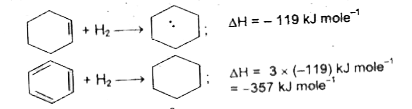

`-357 = Delta_(t)^(@)("Products") - DeltaH_(t)^(@)("Reactant")`
`=-156 - DeltaH_(t)^(@)("Benzeene")`
`Delta_(t)^(@)("Benzene") = (-156 + 357) kJ mol^(-1) = 201 kJ mol^(-1)`
Resonance energy `(DeltaH_(t)^(@))("Benzene Alcohol") - DeltaH_(t)^(@) ("Benzene theoretical")`
`[DeltaH_(t)^(@) ("Benzene Alcohol")] = 49 kJ "mol"^(-1)`
`C_(6)H_(6) (i) + 15/2 O_(2)(g) to 6CO_(2)(g) + 3H_(2)O(l)`
`DeltaH_("reaction")^(@) = 6(DeltaH_(t)^(@))_(CO_(2)) + 3(DeltaH_(t)^(@))_(H_(2)O) - (DeltaH_(t)^(@))_("Benzene")`
`=6(-393.5) + 3(-285.8) - 49`
`=3267.4 kJ mol^(-1)`
Promotional Banner

Similar Questions

Explore conceptually related problems

The enthalpy of hydrogenation of cyclohexene is -119.5kJ mol^(-1) . If resonance energy of benzene is -150.4kJ mol^(-1) , its enthalpy of hydrogenation would be :

The enthalpy of hydrogenation of cyclohexene is -119.5kJ mol^(-1) . If resonance energy of benzene is -150.4kJ mol^(-1) , its enthalpy of hydrogenation would be :

The enthalpy of hydrogenation of cyclohexene is -119.5kJ mol^(-1) . If resonance energy of benzene is -150.4kJ mol^(-1) , its enthalpy of hydrogenation would be :

If enthalpy of hydrogenation of cyclohexene is [-x kJ mol^-1] and resonance energy of benzene is [-y kJ mol^-1] then the enthalpy of hydrogenation of benzene will be

Given Delta_(i)H^(Theta)(HCN) = 45.2 kJ mol^(-1) and Delta_(i)H^(Theta)(CH_(3)COOH) = 2.1 kJ mol^(-1) . Which one of the following facts is true?

Consider the reaction: 4NH_(3)(g) +5O_(2)(g) rarr 4NO(g) +6H_(2)O(l) DeltaG^(Theta) =- 1010.5 kJ Calculate Delta_(f)G^(Theta) [NO(g)] if Delta_(f)G^(Theta) (NH_(3)) = -16.6 kJ mol^(-1) and Delta_(f)G^(Theta) [H_(2)O(l)] =- 237.2 kJ mol^(-1) .

Find the enthalpy of formation of hydrogen flouride on the basis of following data: Bond energy of H-H bond =434 kJ mol^(-1) Bond energy of F-F bond =158 kJ mol^(-1) Bond enegry of H -F bond =565 kJ mol^(-1)

The enthalpy change for the combustion of N_(2)H_(4)(l) (Hydrazine) is -622.2 kJ mol^(-1) . The products are N_(2)(g) and H_(2)O(l) . If Delta_(f)H^(Theta) for H_(2)O(l) is -285.8 kJ mol^(-1) . The Delta_(f)H^(Theta) for hydrazine is

Calculate the resonance energy of toluene (use Kekule structure from the following data C_(7)H_(8)(l) +9O_(2)(g) rarr 7CO_(2)(g) +4H_(2)O(l)+ DeltaH, DeltaH^(Theta) =- 3910 kJ mol^(-1) C_(7)H_(8)(l) rarr C_(7)H_(8)(g), DeltaH^(Theta) = 38.1 kJ mol^(-1) Delta_(f)H^(Theta) (water) =- 285.8 kJ mol^(-1) Delta_(f)H^(Theta) [CO_(2)(g)] =- 393.5 kJ mol^(-1) Heat of atomisation of H_(2)(g) = 436.0 kJ mol^(-1) Heat of sublimation of C(g) = 715.0 kJ mol^(-1) Bond energies of C-H, C-C , and C=C are 413.0, 345.6 , and 610.0 kJ mol^(-1) .

Calculate the standard Gibbs free energy change from the free energies of formation data for the following reaction: C_(6)H_(6)(l) +(15)/(2)O_(2)(g) rarr 6CO_(2)(g) +3H_(2)O(g) Given that Delta_(f)G^(Theta) =[C_(6)H_(6)(l)] = 172.8 kJ mol^(-1) Delta_(f)G^(Theta)[CO_(2)(g)] =- 394.4 kJ mol^(-1) Delta_(f)G^(Theta) [H_(2)O(g)] =- 228.6 kJ mol^(-1)

