For gases behaving as per PV= nRT
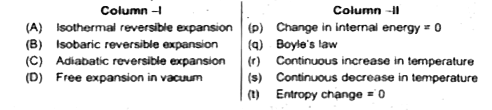
For gases behaving as per PV= nRT
Text Solution
Verified by Experts
The correct Answer is:
A, B, C, D



Similar Questions
Explore conceptually related problems
Assertion: van der Waals equation is applicable only to non-ideal gases. Reason: Ideal gases obey the equation PV=nRT .
Assertion: van der Waals equation is applicable only to non-ideal gases. Reason: Ideal gases obey the equation PV=nRT .
Assertion : Compressibility factor for ideal gas is one. Reason : For an ideal gas PV = nRT equation is obeyed.
In general gas equation, PV = nRT, V is the volume of :
Out of the three states of matter, only the gases have most of the physical properties common. They neither have definite shapes nor volumes. Upon mixing they form homogeneous mixture irrespective of their nature and can also be compressed on applying pressure. In addition to these, the gases obey different gas laws such as Boyle's Law, Charles's Law, Dalton's Law of partial pressures, Graham's Law of diffusion etc. Based upon these laws, ideal gas equation PV = nRT has been derived. For an ideal gas, number of moles per litre in terms of its pressure P, gas constant R and temperature T is :
Ideal gas equation is represented as PV=nRT . Gases present in universe were fond ideal in the Boyle's temperature range only and deviated more from ideal gas behavior at high pressure and low temperature. The deviation are explained in term of compressibility factor z . For ideal behavior Z=(PV)/(nRT)=1 . the main cause to show deviavtion were due to wrong assumptions made about forces oif attractions (which becomes significant at high pressure ) and volume V occupied by molecules in PV=nRT is supposed to be volume of gas or the volume of container in which gas is placed by assuming that gaseous molecules do not have appreciable volume. Actually volume of the gas is that volume in which each molecule of gas can move freely. If volume occupied by gaseous molecule is not negligible, then the term V would be replaced by the ideal volume which by available for free motion of each molecule of gas in 1 mole gas. V_("actual")= volume of container -volume occupied by molecules =v-b Where b represent the excluded volume occupied by molecules present in one mole of gas. Similarly for n mole gas V_("actual")=v-nb The ratio of coefficient of thermal expansion alpha=(((delV)/(delT))_(P))/V and the isothermal compressibility beta=-((delV)/(delP)_(T)) for an ideal gas is:
Out of the three states of matter, only the gases have most of the physical properties common. They neither have definite shapes nor volumes. Upon mixing they form homogeneous mixture irrespective of their nature and can also be compressed on applying pressure. In addition to these, the gases obey different gas laws such as boyle's Law, Charles's Law, Dalton's Law of partial pressures, Graham's Law of diffusion etc. Based upon these laws, ideal gas equation PV = nRT has been derived. 4-4 g of a gas at STP occupies a volume of 2.224 L. The gas can be :
Out of the three states of matter, only the gases have most of the physical properties common. They neither have definite shapes nor volumes. Upon mixing they form homogeneous mixture irrespective of their nature and can also be compressed on applying pressure. In addition to these, the gases obey different gas laws such as Boyle's Law, Charles's Law, Dalton's Law of partial pressures, Graham's Law of diffusion etc. Based upon these laws, ideal gas equation PV = nRT has been derived. Which pair of gaseous species diffuse through a small jet with the same rate of diffusion at same P and T ?
Out of the three states of matter, only the gases have most of the physical properties common. They neither have definite shapes nor volumes. Upon mixing they form homogeneous mixture irrespective of their nature and can also be compressed on applying pressure. In addition to these, the gases obey different gas laws such as Boyle's Law, Charles's Law, Dalton's Law of partial pressures, Graham's Law of diffusion etc. Based upon these laws, ideal gas equation PV = nRT has been derived. Same mass of CH_(4) and H_(2) at taken in a container. The partial pressure caused by H_(2) is
Out of the three states of matter, only the gases have most of the physical properties common. They neither have definite shapes nor volumes. Upon mixing they form homogeneous mixture irrespective of their nature and can also be compressed on applying pressure. In addition to these, the gases obey different gas laws such as boyle's Law, Charles's Law, Dalton's Law of partial pressures, Graham's Law of diffusion etc. Based upon these laws, ideal gas equation PV = nRT has been derived. When the product of pressure and volume is plotted against pressure for a given amount of a gas, the obtained is
Recommended Questions
- For gases behaving as per PV= nRT
Text Solution
|
- For real gases, (PV)/(nRT) ........
Text Solution
|
- Gas equation PV = nRT is obeyed by
Text Solution
|
- Gas equation PV = nRT is obeyed by
Text Solution
|
- सिद्ध करो- PV=nRT
Text Solution
|
- गैस समीकरण PV= nRT में R क्या है। R का मान लीटर एटमास्फियर प्...
Text Solution
|
- Compressibility factor (Z=(PV)/(nRT)) is plotted against pressure ...
Text Solution
|
- For ideal gases pV // nRT is :
Text Solution
|
- Assertion : Compressibility factor of ideal gases is one. Reason : For...
Text Solution
|