Home
Class 12
CHEMISTRY
Liquids X and Y form an ideal solution. ...

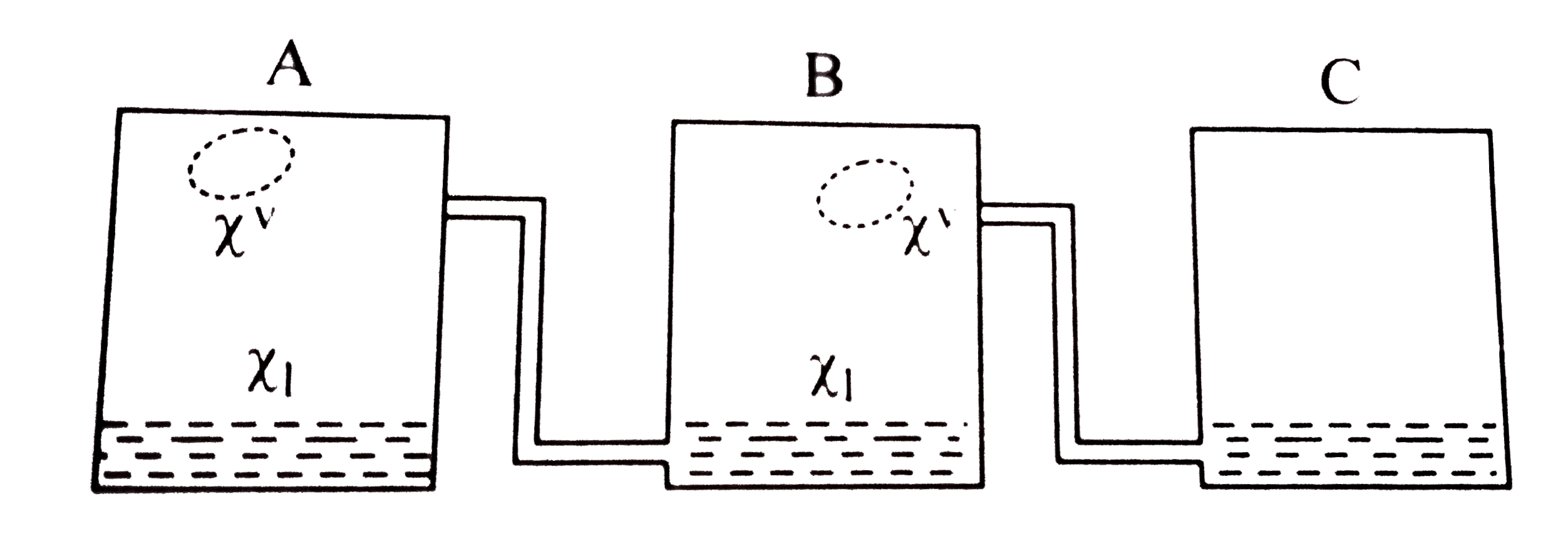
Liquids `X` and `Y` form an ideal solution. The vapour pressure of `X` and `Y` at `100^(@)C` are `300` and `100 mm` of `Hg`, respectively. Suppose that a solution composed of `1 mol` of `X` and `1 mol` of `Y` at `100^(@)C` is collected and condensed. This condensate is then heated at `100@C` and vapour is again condensed to form a liquid `A`. What is the mole fraction of `X` in `A` ?

Text Solution

Verified by Experts

Vapour presure due to vapours above tha solution
`P_(T)=X_(A)P_(A)^(@)+X_(B)P_(B)^(@)`
`P_(T)=300X_(A)+100 X_(B)`
It is given that in vapour pahse each of A and B are one mole each. Hence of them have mole fraction`0.5` in vaour phase.
`0.5=(300X_(A))/(P_(T))" "...(1)`
`0.5=(100X_(B))/(P_(T))" "...(2)`
And `X_(A)+X_(B)=1 " "...(3)`
Solving Eqs (1) ,(2) and (3) we get
`X_(A)=0.25 and X_(B)=0.75`
`P_(T)=300xx0.25+100xx0.75=75=150` mm
After condensation of vapours,
In condenstate (1)
`X_(A)=0.5`
`X_(B)=0.05`
`P_(T)=0.5xx300+0.5xx100`
`=150+50=200mm`
Mole fraction of A and B in vapour phase of condenstate
`Y_(A)=(P_(A))/(P)=0.75`
`V_(B)=1-0.75=0.25`
When the vapiours of the condenstate (1) will again be vapourizex in condenstate (2) liquid L
`X_(A)=0.75X_(B)=0.25`, where `X_(A).. and X_(B)..` are mole fractions of A and B in liquid L.
`P_(T)..=300xx0.75+100xx0.25=2556+25-=250 mm`
and mole fraction of A in vapour phase of the condenstate (2) is given by
`Y_(A)..=(225)/(250)=0.9`
Promotional Banner

Similar Questions

Explore conceptually related problems

When vapour condenses into liquid

Two liquids A and B form an ideal solution of 1 mole of A and x moles of B is 550 mm of Hg. If the vapour pressures of pure A and B are 400 mm of Hg nd 600 mm of Hg respectively. Then x is-

The vapour pressures of pure liquid A and pure liquid B at 20^(@)C are 22 and 75 mm of Hg respectively. A solution is prepared by mixing equal moles of A and B. Assuming the solution to be ideal, calculate the vapour pressure of the solution.

The vapoure pressure of two pure liquids A and B, that from an ideal solution are 100 and 900 torr respectively at temperature T. This liquid solution of A and B is composed of 1 mole of A and 1 mole of B. What will be the pressure, when 1 mole of mixture has been vaporized?

Vapour pressure of methyl alcohol and dichloromethane at 27^@ C are 100 mm HG and 350 mm Hg respectively. Vapour pressure of the solution obtained by mixing 1.5 mole of methyl alcohol and 0.5 mole of dichloromethane at 27^@ C is

At 25^(@)C, 1 mol of A having a vapour pressure of 100 torr and 1 mole of B having a vapour pressure of 300 torr were mixed. The vapour at equilibrium is removed, condensed and the condensate is heated back to 25^(@)C . The vapour now formed are again removed, recondensed and analyzed. what is the mole fraction of A in this condensate?

The vapour pressure of a pure liquid at 25^(@)C is 100 mm Hg. Calculate the relative lowering of vapour pressure if the mole fraction of solvent in solution is 0.8.

The vapour pressures of benzene and toluene at 293 K are 75 mm and 22 mm Hg respectively. 23.4g of benzene and 64.4 g of toluene are mixed. If the two form and ideal solution, calculate the mole fraction of benzene in the vapour phase assuming that the vapours are in equilibrium with the liquid mixture at this temperature.

The vapour pressure of pure liquid A and liquid B at 350 K are 440 mm and 720 mm of Hg. If total vapour pressure of solution is 580 mm of Hg then the mole fraction of liquid A in vapour phase will be :-

Benzene and toluene form ideal solution over the entire range of composition. The vapour pressure of pure benzene and naphthalene at 300K are 50.71 mm Hg and 32.06mm Hg , respectively. Calculate the mole fraction of benzene in vapour phase if 80g of benzene is mixed with 100g of naphthalene.
