Home
Class 12
CHEMISTRY
Consider following figure and answer the...

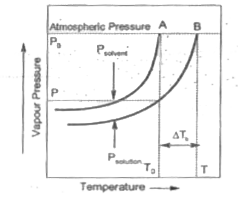
Consider following figure and answer the questions at the end of it. Figure explains elevation in boiling point when a non-volatile solute is added to a solvent.

Variation of vapour pressure with temperature and showing elevation in boiling point.
A complex of iron and cyanide ions is 100% ionized at 1m (molal). If elevation in boiling point is `2.08^(@)(K_(b)=0.52^(@)mol^(-1)kg)` then the complex is:

A

`K_(3)[Fe(CN)_(6)]`

B

`Fe(CN)_(2)`

C

`K_(4)[Fe(CN)_(6)]`

D

`Fe(CN)_(4)`

Text Solution

Verified by Experts

The correct Answer is:

A
Promotional Banner

Similar Questions

Explore conceptually related problems

Consider following figure and answer the questions at the end of it. Figure explains elevation in boiling point when a non-volatile solute is added to a solvent. Variation of vapour pressure with temperature and showing elevation in boiling point. Elevation in boiling point of an aqueous urea solution is 0.52^(@).(K_(b)=0.52^(@)mol^(-1)kg) . Hence, mole fraction of urea in this solution is:

A complex of iron and cyanide ions is 100% ionised ar 1 m (molal). If its elevation in b.p.is 2.08 then the complex is (K_(b)=0.52^(@)mol^(-1)kg) ,

Consider following figure and answer the questions at the end of it. Figure explains elevation in boiling point when a non-volatile solute is added to a solvent. Variation of vapour pressure with temperature and showing elevation in boiling point. Given that DeltaT_(b) is the elevation in boiling point of the solvent in a solution of molality m then underset(mto0)(Lt)((DeltaT_(b))/(m)) is equal to

Figure explains elevation in boiling point when a non-volatile solute is added to a solvent. Variation of vapour pressure with temperaure and elevation in boiling point is marked. Elevation in b.p of an aqueous urea solution is 0.52^(@) (K_(b) = 0.52^(@) mol^(-1)kg) . Hence, mole fraction of urea in this solution is:

Illustrate elevation in boiling point with the help of vapour pressure-temperature curve of a solution. Show that elevation in boiling point is a colligative property.

If the solution boils at a temperature T_1 and solvent at a temperature T_2 the elevation of boiling point is given by:

For [CrCl_(3).xNH_(3)] , elevation in boiling point of one molal solution is double of one molal solution of glucose , hence x is if complex is 100% ionised :

Will the elevation in boiling point be same if 0.1 mol of Sodium chloride or 0.1 mol of sugar is dissolved in 1L of water ? Explain.

Lowering of vapour pressure of 1.00 m solution of a non-volatile solute in a hypothetical solvent of molar mass 40 g/mole at its normal boiling point is:

Elevation in boiling point of an aqueous solution of urea is 0.52 ( k_(b) "for water"=0.52K"molality"^(-1)) . The mole fraction of urea in this solution is :
