Home
Class 12
CHEMISTRY
The following diagram shown as electroch...

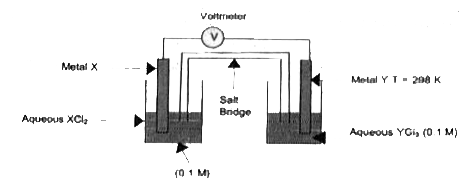
The following diagram shown as electrochemical cell in which the respective half-cells contains aqueous 1.0M solutions of the salts `XCl_(2) and YCl_(3)`. Given that
`3X(s)+2Y^(3+) (aq) to 3X^(2)(aq)+2Y(s) epsi_("cell") gt 0`

`E_("cell")` of the above designed cell is if standard emf of cell is -0.20 V.

A

`(0.20+(0.0591)/(2))V`

B

`(0.20-(0.0591)/(3))V`

C

`(-0.20+(0.0591)/(6))V`

D

`+2.0V`

Text Solution

Verified by Experts

The correct Answer is:

C
Promotional Banner

Similar Questions

Explore conceptually related problems

The following diagram shown as electrochemical cell in which the respective half-cells contains aqueous 1.0M solutions of the salts XCl_(2) and YCl_(3) . Given that 3X(s)+2Y^(3+) (aq) to 3X^(2)(aq)+2Y(s) epsi_("cell") gt 0 if salt-bridge is removed:

The following diagram shown as electrochemical cell in which the respective half-cells contains aqueous 1.0M solutions of the salts XCl_(2) and YCl_(3) . Given that 3X(s)+2Y^(3+) (aq) to 3X^(2)(aq)+2Y(s) epsi_("cell") gt 0 Cell reaction is non spontaneous:

The following diagram shown as electrochemical cell in which the respective half-cells contains aqueous 1.0M solutions of the salts XCl_(2) and YCl_(3) . Given that 3X(s)+2Y^(3+) (aq) to 3X^(2)(aq)+2Y(s) epsi_("cell") gt 0 Which of the following statements is correct? I. The electrode made from metal X has positive polarity II. Electrode Y Is the anode II. Tho flow of electrons is from Y to X IV. The reaction at electrode X is an oxidation V. The salt bridge would most likely contain silver nitrate

The following diagram shows the setup of an electrochemical cell in which the respective half cells contain aqueous 1.0 M solutions of the salts XCl_(2) and YCl_(3) . Given that 3X(s)+2Y^(3+)(aq)to3X^(2+)(aq)+2Y(s)E_(cell)Llt0 Which of the following statements is correct?

The following diagram shown as electrochemical cell in which the respective half-cells contains aqueous 1.0M solutions of the salts XCl_(2) and YCl_(3) . Given that 3X(s)+2Y^(3+) (aq) to 3X^(2+)(aq)+2Y(s) epsi_("cell") gt 0 E_(X//X^(2+))^@=0.20v, E_(Y//Y^(3+))^(@)=0.40 V " the "E_("cell")^(@) of the above designed cell is

The cell in which the following reaction occurs : 2Fe_(aq)^(3+) + 2I_(aq)^(-) to 2Fe_(aq)^(2+) + I_(2(s)) "has" E_("cell")^(o) = 0.236 V "at" 298 K The equilibrium constnat of the cell reaction is

E.M.F. of Ni(s) | Ni^(2+) (aq)||Cu^(2+) (aq)| Cu(s) cell can be increased by

The standard cell potential of: Zn(s) abs( Zn^(2+) (aq) )abs( Cu^(2+) (aq)) Cu (s) cell is 1.10 V The maximum work obtained by this cell will be

The logarithm of the equilibriium constant of the cell reaction corresponding to the cell X(s)|x^(2+)(aq)||Y^(+)(aq)|Y(s) with standard cell potential E_(cell)^(@)=1.2V given by

In a cell reaction, Cu_((s))+ 2Ag_((aq))^(+) to Cu_((aq))^(2+) + 2Ag_((s)) E_"cell"^@ =+0.46 V . If the concentration of Cu^(2+) ions is doubled then E_"cell"^@ will be
