Home
Class 12
CHEMISTRY
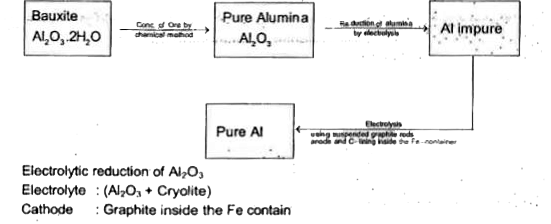
Extraction of aluminum can be understo...

Extraction of aluminum can be understood by

The molten electrolytes contains `Na^(+), AI^(3+), Ca^(2+)` but only AI gets deposited at cathode because :

A

Standard reduction potential of AI is more than those of Na & Ca

B

Standard oxidation potential of AI is more than those of Na & Ca

C

Disharge potential `AI^(3+)` is higher than `Na^(+) & Ca^(2+)`

D

Graphite reacts only with `AI^(3+)` and not with `Na^(+) & Ca^(2+)`

Text Solution

Verified by Experts

The correct Answer is:

A

It is a fact.
Hence, (A) is the correct answer.
Promotional Banner

Similar Questions

Explore conceptually related problems

Extraction of aluminium can be understood by : Electrolytric reduction of Al_(2) O_(3) : Electrolysis : Al_(2) O_(3) + Cryolite + CaF_(2) Cathode : Carbon inside the Fe container Anode : Graphite rods. The molten electrolytes contain Na^(oplus),Al^(3+) and Ca^(2+) but only Al gets deposited at cathode because,

Extraction of aluminum can be understood by The function of fluorspar (CaF_(2)) is :

Extraction of aluminum can be understood by Coke powder is spreaded over the molten electrolyte due to :

Extraction of aluminium can be understood by : Electrolytric reduction of Al_(2) O_(3) : Electrolysis : Al_(2) O_(3) + Cryolite + CaF_(2) Cathode : Carbon inside the Fe container Anode : Graphite rods. Coke power is spread over the molten electroltyte to.

Extraction of aluminium can be understood by : Electrolytric reduction of Al_(2) O_(3) : Electrolysis : Al_(2) O_(3) + Cryolite + CaF_(2) Cathode : Carbon inside the Fe container Anode : Graphite rods. The function of fluorspar (CaF_(2)) is.

Extraction of aluminium can be understood by : Electrolytric reduction of Al_(2) O_(3) : Electrolysis : Al_(2) O_(3) + Cryolite + CaF_(2) Cathode : Carbon inside the Fe container Anode : Graphite rods. The purpose of adding cryolite is.

Dow's process of extraction of Mg involves extraction of Mg from sea water. Sea water is concentrated in sun-light and is then treated with slaked lime. Magnesium hydroxide is heated in a stream of HCl to give MgCl_(2) which is electrolysed to discharge Mg. The mixture is in the ratio 35% MgCl_(2)+50% NaCl+15% CaCl_(2) . NaCl and CaCl_(2) are added to lower the fusion temperature and to increases the conductance. Mg^(2+) +Ca(OH)_(2) to Mg(OH)_(2)+Ca^(2+) Mg(OH)_(2)+2HCl to MgCl_(2)+2H_(2)O(l) Electrolysis of fused MgCl_(2) hArr Mg^(2+)+2Cl Mg^(2+)+2e^(-) to Mg ( At Cathode) 2Cl^(-) to Cl_(2)+2e^(-) (At Anode) Mg electrolysed is protected from atmospheric oxidation by a blanket of inert gases. Molten mixture contains Mg^(2+), Na^(+) and Ca^(2+) but at cathode only Mg^(2+) is discharged because :

For extraction of sodium from NaCI , the electrolytic mixture NaCI + Na_(3)AIF_(6) +CaCI_(2) is used. During extraction process, only sodium is deposited on cathode but K and Ca do not because

On passing 1 Faraday charge through the electrolytic cells containing Ag^(+),Ni^(2+),Cr^(3+) ions solution, the mass of deposited Ag is (At mass = 108 u ), Ni (At mass = 59u) and Cr (At mass = 52U):

Consider the following metallurgical processes : (1) Heating impure metal with CO and distilling the resulting volatile carbonyl (BP 43^@ C) and finally decomposing at 150^@C to 230^@ C to get pure metal. (2) Heating the sulphide ore in air until a part is converted to oxide and then further heating in the absence of air to let the oxide react with unchanged sulphide. (3) Electrolysing the molten electrolyte containing CaCl_(2) to obtain the metal The processes used for obtaining sodium, nickel, and copper are, respectively
