Home
Class 12
CHEMISTRY
In Blast Furnace Fe(2)O(3) is reduced to...

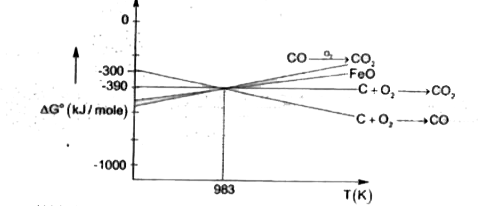
In Blast Furnace `Fe_(2)O_(3)` is reduced to FeO in reduction zone by CO, where temperature varies from about 300 to `800^(@)C`. By using given Ellingham diagram choose the correct statement(s) of the following ?

A

below 983 K FeO is reduced by CO

B

above 983 K FeO can be reduced to Fe by CO

C

at 1000 K FeO is reduced by C in which CO formation is more
favourable

D

at 983 K none of C and CO can completely reduce FeO to Fe

Text Solution

Verified by Experts

The correct Answer is:

A, C, D

At 983 K there will be an equilibrium of all the process shown.
Promotional Banner

Similar Questions

Explore conceptually related problems

Choose the correct statement(s) from the following option for given diagram

Metals are extracted from their ores by a wide variety of techniques. The most common ores are oxides. Most metals are obtained by direct treatment of theirs ores with chemical agents, but the extraction of certain others require electrolysis. An example of the former type of process is the extraction of iron from its oxide, described by the following equation : Fe_(2) O_(3) + 3C rarr 2Fe + 3CO The relative ease of extraction of a metal from its oxide can be estimated using the Ellingham diagram, as shown in the figure. The diagram plots the free energies of formation of various oxides per mole of consumed oxygen as a function of absolute temperature. Which of the following best explains why the free energy of formation of Fe_(2)O_(3) becomes less negative as the temperature is increased.

At temperature above 1073K coke can be used to reduce FeO to Fe . How can you justify this reduction with Ellingham diagram?

Metallurgy of Fe is carried in Blast furnace. Blast furnace is divided in following zones. a. Combustion zone b. Fusion zone c. Reduction zone d. Preheating zone At 350^(@)C which of the reaction is better reducing agent ?

Read the following statements :- (I) Al has greater affinity than that of Cr, for oxygen (II) Al can be used for reduction of Fe_(2)O_(3) (III) Carbon is used for reduction of copper oxide (CuO) (IV) SnO_(2) can be reduced by carbon Choose the correct set of statement(s)

The chief ores of iron are haemalite (Fe_2O_3) , magnetite (Fe_3O_4) , limonite (FeO(OH)) and siderite (FeCO_3) .In the extraction of iron , oxides ores of iron, after concentration through calcination/roasting in reverberatory furnace are mixed with lime stone and coke and fed into a blast furnace. Here, the oxide is reduced to the metal. Which of the following is obtained as a slag in the extraction of iron from haematite ore ?

Consider the following statements : S_(1) : In extration of iron from haematite ore, the reduction reactions take place only in the lower temperature range in the blast furnace. S_(2) : Calamine in an carbonate ore of zince. S_(3) : The principle ore of aluminium , bauxite , usually contains silica, iron oxides and titanium oxide as impurities. S_(4) : Solidified copper obtained from silica lined conventor ( Bessemer converter ) has blistered appearance due to the evolution of SO_(2) . Which are correct statements?

The equation of a wave distrubance is a given as y= 0.02 sin ((pi)/(2)+50pi t) cos (10 pix) , where x and y are in metre and t is in second . Choose the correct statement (s).

Mention the temperature at which carbon can reduce Fe_(2)O_(3) in blast furnace.

Cartain materials such as turpentine oil, unsaturated organic compound, phosophorus, metals such as Zn , and Pb , etc., can absorb O_(2) from air in the presence of H_(2)O , which is converted to absorb O_(2) from air in the presence of H_(2)O , which is converted to H_(2)O_(2) . This is called autoxidation. Intermolecular redox reactions are those in which one molecule is oxidised and the other is reduced. Intramolecular redox reactions are those in which oen atom of a molecule is oxidised and the other atom is reduced. Which of the following statements about the reaction is // are correct? 2AsCl_(4)^(ө)+3Znrarr2Au+3Zn^(2+)+8Cl^(ө)
