Home
Class 12
CHEMISTRY
A(1) & A(2) are two ores of metal M. Ar ...

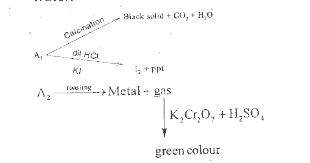
`A_(1) & A_(2)` are two ores of metal M. Ar on calcination gives black precipitate, `CO_(2)`& water.

Text Solution

Verified by Experts

`CuCO_(3), Cu(OH)_(2), Cu_(2)S, Cu, Cuo, Cu_(2)l_(2), SO_(2)`
`A_(1) = Cu(OH)_(2), CuCO_(3)`
`A_(2)= Cu_(2)S`
`Cu(OH)_(2) CuCO_(3)overset(cabination)to 2CuO+CO_(2)+overset(H_(2)O)(Black 0Solid)`
`Cu(OH)_(2)CuCO_(3)overset(dillHCl)toCUCl_(2)+CO_(2)+3H_(2)O`
`2CU_(2)Cl_+4Klto2Cu_(2)I_(2)+I_(2)+4KCI`
`underset(A_(2))(2Cu_(2)S)+3O_(2)to2CU_(2)O+2SO_(2)`
Cu_(2)S+3O_(2)to6Cu+SO_(2)`
Promotional Banner

Similar Questions

Explore conceptually related problems

A_(1) and A_(2) are two ores of metal M.A_(1) on calcination gives a black precipitate, CO_(2) and water. Identify A_(1) and A_(2) . .

Let ABC and AB'C be two non-congruent triangles with sides BC=B'C=5, AC=6, and angleA is fixed. If A_(1) and A_(2) are the area of the two triangles ABC and AB'C, then the value of (A_(1)^(2)+A_(2)^(2)-2A_(1)A_(2)cos 2A)/((A_(1)+A_(2))^(2)) is

If a_(1) and a_(2) aare two non- collineaar unit vectors and if |a_(1)+a_(2)|=sqrt(3), ,then value of (a_(1)-a_(2)).(2a_(1)-a_(2)) is

If a_(1) and a_(2) are two non- collinear unit vectors and if |a_(1)+a_(2)|=sqrt(3), ,then value of (a_(1)-a_(2)).(2a_(1)-a_(2)) is

If A_(1),A_(2) are two A.M.'s and G_(1),G_(2) be two G.M.'s between two positive numbers a and b, then (A_(1)+A_(2))/(G_(1)G_(2)) is equal to (i) (a+b)/(ab) (ii) (a+b)/2 (iii) (a+)/(a-b) (iv) None of these

If vec(a_(1)) and vec(a_(2)) are two non-collinear unit vectors and if |vec(a_(1)) + vec(a_(2))|=sqrt(3) , then the value of (vec(a_(1))-vec(a_(2))). (2 vec(a_(1))+vec(a_(2))) is :

The spectrum of a black body at two temperatures 27^(@)C and 327^(@)C is shown in the figure. Let A_(1) and A_(2) be the areas under the two curves respectively. Find the value of (A_(2))/(A_(1))

A_(1) and A_(2) are two vectors such that |A_(1)| = 3 , |A_(2)| = 5 and |A_(1)+A_(2)| = 5 the value of (2A_(1)+3A_(2)).(2A_(1)-2A_(2)) is

If a_(1), a_(2), a_(3), a_(4), a_(5) are consecutive terms of an arithmetic progression with common difference 3, then the value of |(a_(3)^(2),a_(2),a_(1)),(a_(4)^(2),a_(3),a_(2)),(a_(5)^(2),a_(4),a_(3))| is

If the quadratic equation a_(1)x^(2)-a-(2)x+a_(3)=0 where a_(1),a_(2),a_(3) in N has two distinct real roots belonging to the interval (1,2) then least value of a_(1) is_______
